
Michigan state park camping fees in 2026 run about $32 to $50 a night for a modern campsite with 20- to 50-amp electric, $20 a night for a rustic site, and $60 to $120 a night for cabins and most other overnight lodging. On top of the site, every vehicle needs a Recreation Passport ($15 for Michigan residents when bought with a plate renewal; $42 a year or $12 a day for nonresidents) and each reservation carries an $8 online booking fee. Those are the Michigan DNR rates that took effect August 1, 2025, and they are the current schedule as of this writing.
Below is the full fee breakdown, what the extras add, what campsites cost at some of the most-searched Michigan state parks, and how a private campground such as The Oaks in Munith, next door to Waterloo Recreation Area, compares.
What are the Michigan state park camping fees in 2026?
The DNR prices campsites by type rather than by park, with a range inside each type that depends on the park’s location, electrical service and how busy it is.
| Site or lodging type | Nightly rate | What you get |
|---|---|---|
| Modern campsite | About $32 to $50 | Electric (20, 30 or 50 amp), flush toilets and showers; a few parks have full hookups |
| Semi-modern campsite | Below modern; varies by park | Either electric or a modern restroom building, not both |
| Rustic campsite (state parks and state forests) | $20 | Vault toilets and a hand pump; no electric |
| Cabins, mini-cabins, yurts and most lodging | $60 to $120 | Enclosed sleeping space; many have no plumbing, so bring linens |
| Deluxe lodging | $160 | Larger or better-equipped units |
| Modern lodges | Up to $236 | Multi-room houses at a handful of parks |
Two things move a site to the top of its range. Campgrounds that fill to at least 85% occupancy carry a 7.5% premium, and high-demand lodges can add a $50 nightly premium. The August 2025 change raised modern and semi-modern sites by $4 to $10 a night; rustic sites did not change.

Michigan state park camping prices beyond the nightly rate
- Recreation Passport. Required to drive into any state park, recreation area or state forest campground, and separate from your camping fee. Michigan residents pay $15 per vehicle when they add it to a license-plate renewal (or $29 for two years), with a $5 convenience fee if bought elsewhere. Nonresidents pay $42 for the year or $12 for a day. Walking or biking in needs no passport.
- Reservation fee. $8 online at MiDNRReservations.com or $10 through the call center, non-refundable, per reservation.
- Changes and cancellations. A $10 fee plus a sliding-scale charge of 10% to 40% of the unused nights, depending on how long you held the site and how many nights you drop.
- Booking window. Campsites and lodging open six months before arrival. Summer weekends at popular parks go on the day they open.
So a two-night weekend on a $45 modern site works out to roughly $98 plus the passport if you don’t already have one. Our guide to Michigan state park camping reservations walks through the booking system.
How much does camping cost at popular Michigan state parks?
Because the DNR prices by site type, the way to estimate a specific park is to know what kind of campground it has. Here are the parks people ask about most.
Hartwick Pines State Park camping
Hartwick Pines, near Grayling, has a 100-site modern campground inside a 9,335-acre park known for one of Michigan’s last stands of old-growth pine and the Hartwick Pines Logging Museum. Every site has 20/30-amp service, and sites 65 to 100 have full hookups with 50 amp, so expect the upper end of the modern range for those. There is also a one-room rustic cabin on Bright Lake that sleeps seven, with propane heat and no electricity.
Warren Dunes State Park campground: do you need tickets?
There are no tickets as such. Vehicle entry to Warren Dunes requires the Recreation Passport, and the campsite is booked separately. The park on Lake Michigan has a 182-site modern campground (Mt. Randall) with electric and some 50-amp sites, a 37-site semi-modern campground (Hilldebrandt) with no electric and vault toilets, and three rustic mini-cabins that sleep six and have electricity. The dune rises 260 feet above the lake, and the park has three miles of shoreline.
Pontiac Lake Recreation Area camping
Pontiac Lake, in Oakland County, has a 176-site modern campground with 20- and 30-amp service at most sites and some 50-amp sites, plus a 25-site rustic equestrian campground that connects to 17 miles of horse trails. It’s best known for an 11-mile mountain-bike trail and a 600-acre all-sports lake. Note that the DNR lists the modern campground as closed for the rest of the 2026 season, so check the park page before you plan.
Fayette Historic State Park campground
Fayette, on the Garden Peninsula in the Upper Peninsula, has a 61-site modern campground in three loops. All sites have 20/30-amp service, and the pull-through sites add 50 amp. The draw is the preserved 1867 to 1891 iron-smelting townsite on Snail Shell Harbor.
Grand Mere State Park camping
Grand Mere, near Stevensville, does not have a campground. It’s a day-use park with sand dunes, half a mile of Lake Michigan shoreline and two inland lakes popular for bluegill fishing. Campers heading there usually stay at Warren Dunes, a few miles south.
What do the Waterloo Recreation Area campgrounds cost?
Waterloo, Michigan’s largest state park in the Lower Peninsula at more than 20,000 acres, has two modern campgrounds and several rustic ones. Portage Lake (136 sites) and Sugarloaf Lake (164 sites) both offer 30- or 50-amp service on every site and fall in the modern range. Green Lake is a 25-site rustic campground at the $20 rate, and there is a 25-site rustic equestrian campground with eight rustic cabins. Waterloo also has a camper cabin, a tiny house and a yurt, which fall into the lodging band. Our team’s honest take on the state campgrounds here: they put you right on the water, and Portage Lake is an all-sports lake where you can ski, fish or jet-ski. See our Waterloo Recreation Area camping guide for how they differ.
How do private campground prices compare to Michigan state park fees?
A private family campground in Michigan generally costs more per night than a state park modern site. The two are funded and priced differently: public parks are supported by camping fees, the Recreation Passport and public capital investment, and they offer fewer on-site amenities. A private campground pays for its water features, events, staff, bathhouses and utilities through the site rate, and it typically offers far more on site.
The Oaks Campground, a private campground next door to Waterloo, is a fair example of the trade:
- Nightly RV sites start around the high $40s and move with the date and site. Tent sites start in the mid $40s. Rates cover 2 adults and 2 children; extra adults are $13 and children 3 to 17 are $9 per night. There is no vehicle pass to buy.
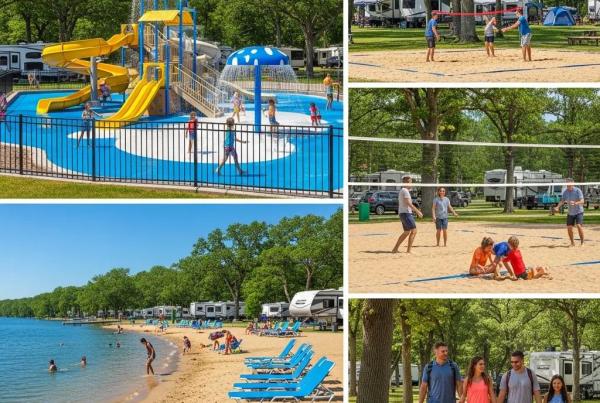
- Included in the site: a sand beach on a spring-fed swim lake, a fishing lake with a dock, about 120 acres of trails for hiking, biking and golf carts, playgrounds, sand volleyball and basketball, laundry, and a full weekend event schedule with food trucks and DJ nights. The Kangaroo Jumper (a bounce pillow added in 2026) is free for campers.
- Paid extra: the Aquaglide floating water park, which needs a wristband. A campground employee explained the difference: the Aquaglide is a big investment to put on the lake every season, so it carries a wristband fee, while the Kangaroo Jumper was a one-time purchase, “a great feature that we can offer without charging extra for it.”
- Hookups: Water-and-electric sites (50 amp on short-term sites) with a gray-water drain and honey-wagon service; no sewer. For 50-amp full hookups, our sister park Walnut Hills in Durand has 80 of them.
Sites at The Oaks are also unusually big, from 35 by 65 feet up to 55 by 120 feet, against an industry norm of roughly 33 by 60. Current prices are on The Oaks rates page. For a deeper side-by-side, read private campground vs state park in Michigan.
How camping prices change by date
State park rates are fixed by site type, so your savings there come from choosing rustic or semi-modern sites and avoiding the occupancy premium at the busiest parks. Private campgrounds, including The Oaks, mostly use dynamic pricing: a base rate per site, then a premium when demand is high (holiday weekends, lakefront sites) or a discount when it’s low. At The Oaks, the discounted windows are:
- May, before Memorial Day weekend
- The weekend after Memorial Day
- The weekends before and after Labor Day
- October, before the season ends on October 20
The Oaks also offers monthly stays at 25% off the nightly rate on non-beachfront sites with a 30-night minimum; see monthly campground rates at The Oaks. For how nightly rates stack up across campground types nationally, see campground prices compared.
Michigan state park camping fees FAQ
Do I need a Recreation Passport if I’m camping?
Yes, if you arrive by motor vehicle. The passport covers entry; the campsite is a separate charge. Private campgrounds don’t require it.
Are there discounts on Michigan state park camping?
The DNR prices by site type and season rather than through discount programs, so the lowest cost is a rustic site or a semi-modern site at a less busy park. At The Oaks, the discounts are monthly stays and a group perk (groups that book 25 or more sites get one day of free pavilion rental).
How far ahead can I reserve a Michigan state park campsite?
Six months before your arrival date, online or through the call center. Pavilions can be booked a year out.
Is The Oaks cheaper than camping at Waterloo?
Per night, no. A modern state park site is the lower-cost option. The Oaks costs more because the beach, trails, events, laundry and free bounce pillow come with the site, and because quiet hours (11 PM to 8 AM) and a license-plate gate (coming for 2027) mean restful nights. Families tell us they choose it for a well-kept, respectful atmosphere with plenty to do without leaving the campground.