
The best places to camp in northern Michigan are mostly public land: state parks on Lake Michigan and Lake Huron, more than 140 state forest campgrounds, the two campgrounds at Sleeping Bear Dunes National Lakeshore, and the big Upper Peninsula parks like Tahquamenon Falls and the Porcupine Mountains. State park sites open for reservation six months ahead on the Michigan DNR reservation site, every vehicle needs a Recreation Passport, and most state forest campgrounds are first-come, first-served with vault toilets and a hand pump.
Below is a short guide to those northern Michigan campgrounds, followed by the trade-off most downstate families run into: the drive. Traverse City is about four and a half hours from Detroit, and the Mackinac Bridge is farther. Walnut Hills Family Campground in Durand is not in northern Michigan. It is about 20 minutes from Flint and an hour and a half from Detroit, and it offers the part of an up-north weekend that families actually use most: a spring-fed swimming lake with a sand beach, a river to float, big old trees and dark skies.
Where are the best places to camp in northern Michigan?
These are the northern Michigan campgrounds people ask us about most, with what each one is known for. Site counts and facilities come from the Michigan DNR and National Park Service pages.
| Park | Where | Camping | Why go |
|---|---|---|---|
| Sleeping Bear Dunes National Lakeshore | Empire / Glen Arbor | Platte River Campground (electric sites, showers, modern restrooms) and D.H. Day Campground (rustic, vault toilets, wooded sites); book on recreation.gov | The dunes, Lake Michigan beaches and the Platte River |
| Hartwick Pines State Park | Grayling | 100-site modern campground with 20/30-amp power; sites 65 to 100 are full hookup with 50 amp | 49 acres of old-growth pine and the logging museum |
| Petoskey State Park | Petoskey / Harbor Springs | Two modern campgrounds (78 and 98 sites), 20/30 amp with a few 50-amp sites | About a mile of Lake Michigan beach and Petoskey stone hunting |
| Wilderness State Park | Carp Lake, near Mackinaw City | Three modern campgrounds (65, 71 and 99 sites), a walk-in tent campground, rustic cabins and two backcountry sites | About 26 miles of shoreline and a designated dark sky preserve |
| Tahquamenon Falls State Park | Paradise (Upper Peninsula) | Lower Falls Modern Campground (188 sites), Rivermouth modern and rustic campgrounds, three walk-in backcountry sites | The Upper Falls, more than 200 feet wide |
| Porcupine Mountains Wilderness State Park | Ontonagon (Upper Peninsula) | Union Bay Modern Campground (100 electric sites), 65 backcountry sites with permits, rustic cabins and yurts | 60,000 acres, 90 miles of trail and Lake of the Clouds |
For a wider list of parks across the state, see our Michigan campgrounds guide, and for the booking process itself, how Michigan state park reservations work.
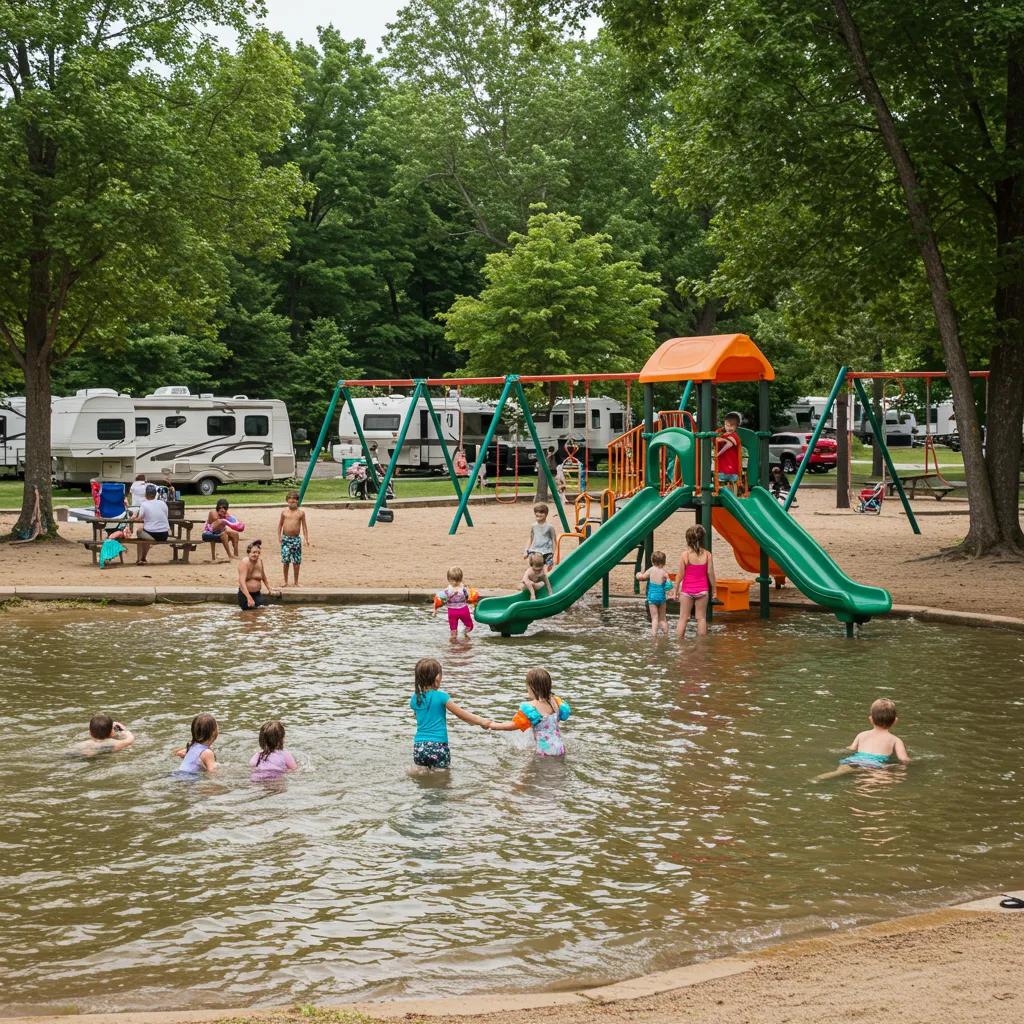
Northern Michigan camping sites that don’t need a reservation
Michigan has more than 140 state forest campgrounds, almost all of them in the northern Lower Peninsula and the Upper Peninsula. Each one sits on or near a lake or river. Expect vault toilets, drinking water from a hand pump, a picnic table and fire pit at every site, and no electricity. Most are first-come, first-served; a few can be reserved. The DNR notes that the roads can be rocky and narrow, so tents, pop-ups and small trailers fit best. This is the classic “northern Michigan camping” people picture, and it is the cheapest way to do it.
If you want even more solitude, dispersed camping is free on state forest land as long as you are more than a mile from a state forest campground and you display a camp registration card at your site. Our rustic camping in Michigan guide covers how that works.
RV camping in northern Michigan: what to check before you book
- Power. Most state park sites are 20/30 amp. Full-hookup and 50-amp sites exist but are limited (Hartwick Pines has 36 of them, for example), so book early if you need them.
- Rig length. Older campgrounds have shorter, tighter sites. Check the site details on the reservation map before you commit a 40-foot fifth wheel.
- Timing. State park campsites open six months ahead, and popular lakeshore parks fill their summer weekends quickly. If your dates are fixed, book the day the window opens.
- The Recreation Passport. It is required for vehicle entry at state parks, recreation areas and state forest campgrounds.
- Cell coverage. It varies a lot in the north and is often absent at state forest campgrounds. Download maps before you go.
National forest campgrounds in the Huron-Manistee are another option for the northern Lower Peninsula; see our national forest campgrounds guide.

The same weekend without the six-hour drive
Here is the trade-off. From Detroit, Traverse City is roughly 245 miles and about four and a half hours; from Flint or Lansing it is still well over three. For a two-night weekend, that is a lot of windshield time for a family with young kids.
Walnut Hills Family Campground in Durand sits between Flint and Lansing, about 20 minutes from Flint and an hour and a half from Detroit. It is not up north, and we say so plainly. What it has is what our team calls a “natural dual water feature,” which is rare in the lower part of the state:
- A spring-fed swimming lake with a sand beach. The spring keeps the water clear and cool. As one campground employee put it, when you swim across you “run into cold pockets of water that are clearly jetting up from the spring underneath, which is very refreshing.” The beach was rebuilt a few years ago with fresh sand and landscaped planters, and it sits right at the front of the park.
- The Shiawassee River. The campground has its own launch, and Cheff’s Canoe Rental, an independent outfitter based at that launch, runs canoe, kayak and tube floats of about two and four hours, plus a 30-to-45-minute float inside the park. The Shiawassee is a designated water trail and runs deeper than the Rifle River, so there is less scraping in low-water years. Details are in our camping and tubing guide.
- The Wibit. A 14-piece floating water park on the lake, open Tuesday through Sunday and free for campers Tuesday through Thursday. Ages 7 and up, with a life jacket provided and a monitor on duty; guests under 16 need a parent present.
- Old-growth trees and rolling hills. Most of the 42-acre park is wooded, with the biggest trees and all-day shade on the north end. Sites are flat; the hills are between them, which is where the name comes from.
- Dark skies. The park is rural enough that stars and meteor showers are easy to see from any site. Walnut Hills keeps a fleet of telescopes and hosts a stargazing event; see our stargazing campgrounds guide.
The RV side is more modern than most northern parks: 201 RV sites, 80 of them full hookup with 50 amp, and many sites 70 to 80 feet long that take rigs up to 45 feet. There are also 18 tent sites and 2 air-conditioned camping cabins. Food trucks come every weekend from Memorial Day through September, and Saturdays bring kids’ crafts, lawn games and a DJ or band at the pavilion. Our team’s advice for a first visit is to arrive Wednesday or Thursday and stay through Sunday, so you get the free Wibit days and the weekend events in one trip. Rates vary by site and date; the Walnut Hills rates page has the current picture, and the full list of features is on the amenities page.
Who should still drive north?
If the point of the trip is Lake Michigan surf, climbing the dunes, waterfalls, or multi-day backpacking, go north; nothing downstate replaces those. If the point is a lake to swim in, a river to float, a campfire under dark skies and something for the kids to do all day, Walnut Hills delivers that with a fraction of the drive. Plenty of our guests do both in the same summer: a long trip up north, and shorter weekends at Walnut Hills in between.
Frequently asked questions
Do I need a Recreation Passport to camp in northern Michigan?
Yes, for any state park, recreation area or state forest campground. It is a vehicle pass, bought with your license plate renewal or at the park. National Park Service and national forest campgrounds have their own fees instead.
Can I camp in northern Michigan without a reservation?
Often, yes. Most state forest campgrounds are first-come, first-served, and dispersed camping on state forest land is free with a registration card. State park and national lakeshore campgrounds are a different story on summer weekends, so reserve those.
Is Walnut Hills in northern Michigan?
No. Walnut Hills is in Durand, between Flint and Lansing in the middle of the Lower Peninsula. Families often compare the two when planning a summer, so this page covers both options. For families coming from the Flint, Lansing or Detroit areas, see our campgrounds near Flint, campgrounds near Lansing and campgrounds near Detroit pages.
What are the best campgrounds in Michigan for families?
The answer splits between public parks (fewer on-site extras, lower cost) and private parks with a water park, events and full hookups. Our family campgrounds in Michigan guide compares the two approaches.