
There’s no single official Michigan campgrounds map, because Michigan’s campgrounds belong to four different systems: state parks and recreation areas (Michigan DNR), state forest campgrounds (also DNR, mostly first-come), national forests and national lakeshores (Recreation.gov), and several hundred private campgrounds that each book directly. The fastest way to find a site is to know which map covers which kind of campground, then narrow by region. This guide lays out those maps, walks through Michigan’s camping regions, and shows exactly where our Walnut Hills Michigan campground in Durand sits on the map and how to read its site map before you book.
Which Michigan camping map should you use?
| Map or tool | What it shows | How to book |
|---|---|---|
| Michigan DNR reservation map (MiDNRReservations.com) | About 140 state park campgrounds with roughly 13,500 sites across 103 state parks and recreation areas, plus harbors and lodging. Click a region, then a campground, to see its site map and photos. | Online or by phone, up to 6 months ahead. See our Michigan state park reservations guide. |
| DNR state forest campground list and map | About 140 rustic state forest campgrounds: vault toilets, hand pumps, no electric. | Mostly first-come, first-served; a few are reservable online. |
| Recreation.gov | Campgrounds in the Huron-Manistee, Hiawatha and Ottawa national forests, and at Sleeping Bear Dunes and Pictured Rocks national lakeshores. | Online, with federal booking windows. |
| Google Maps and campground websites | Private campgrounds, which is where you’ll find full hookups, water parks, cabins and weekend events. | Directly with each campground. |
A useful habit: search the public maps first to see what’s near your destination, then search “campgrounds near” that town on Google Maps to find the private parks the public maps leave out.
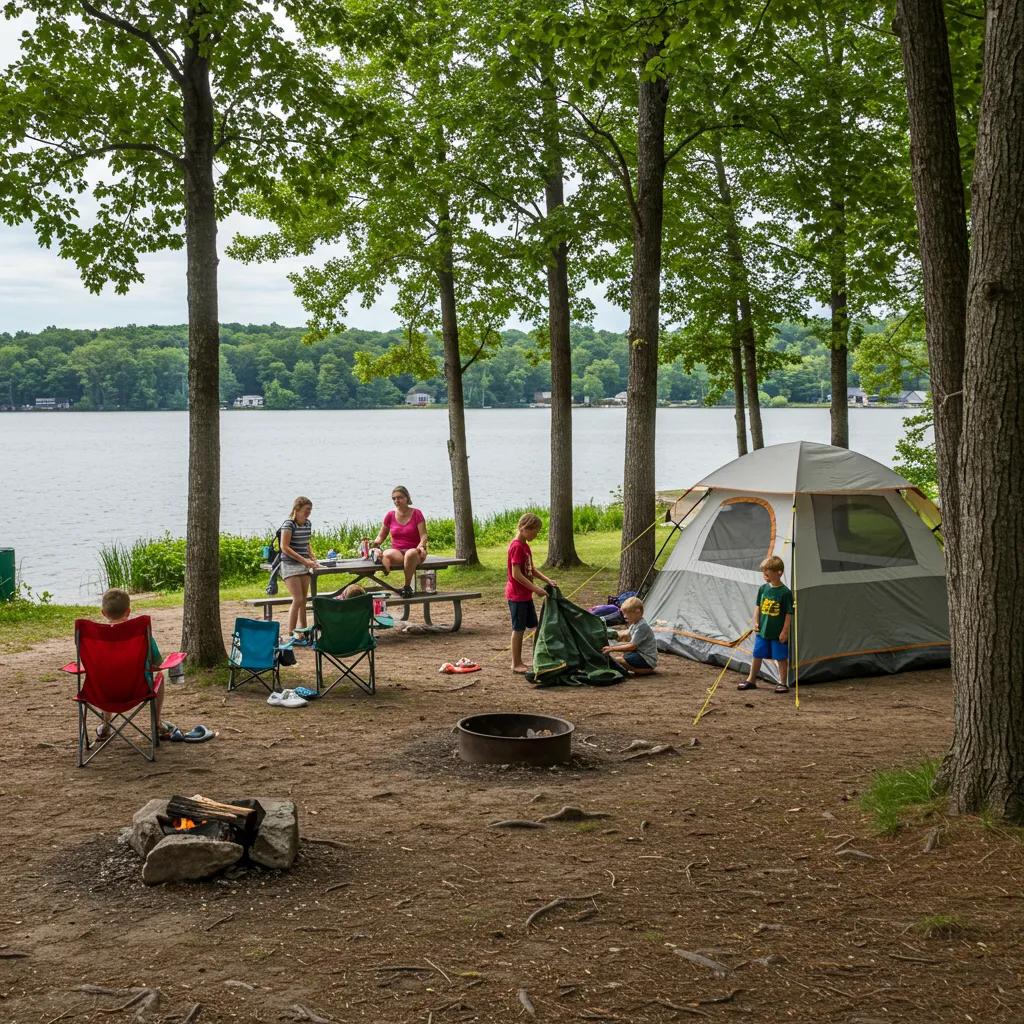
Map of campgrounds in Michigan by region
Michigan camping splits into four regions, and the drive time from Detroit, Flint, Lansing or Grand Rapids is usually what decides which one you pick.
| Region | What it’s known for | Examples |
|---|---|---|
| Southeast and mid-Michigan (Detroit, Flint, Lansing, Ann Arbor, Jackson) | Short drives, inland lakes and rivers, recreation areas with big trail systems, and the state’s largest concentration of private family campgrounds | Walnut Hills (Durand), The Oaks (Munith), Waterloo Recreation Area, Pinckney Recreation Area, Sleepy Hollow State Park, Hayes State Park |
| West Michigan (Lake Michigan shore) | Beach parks and dunes; the most competitive state park reservations in Michigan | Holland, Grand Haven, Ludington and Warren Dunes state parks |
| Northern Lower Peninsula | Big lakes, forests and the Sleeping Bear Dunes shoreline; longer drives and busy summer weekends | Wilderness and Petoskey state parks, Sleeping Bear Dunes, Huron-Manistee National Forests |
| Upper Peninsula | Waterfalls, Lake Superior, remote rustic camping | Tahquamenon Falls and Porcupine Mountains state parks, Pictured Rocks, Hiawatha and Ottawa national forests |
If you live in the southern half of the state, the southeast region is the one most families overlook. You can be set up at a campsite with a swimming lake and a river in about an hour instead of spending six hours of a long weekend in the car. Our Michigan campgrounds overview covers the private options in more detail.
Where is Walnut Hills on the Michigan camping map?
Walnut Hills Family Campground is at 7685 Lehring Road in Durand, Michigan, in Shiawassee County, on the Shiawassee River. On the map it sits between Flint and Lansing, south of Owosso and north of Howell and Fenton, which is why most of our campers come from Flint and Genesee County, Lansing, the north Detroit suburbs in Oakland and Macomb counties, and the Saginaw, Bay City and Owosso area. Durand itself is a train town, home to Durand Union Station, and you’ll probably wait at a crossing on the way in.
What you’ll find when you get there, on 42 acres:
- 201 RV sites, including 80 full-hookup 50-amp sites and many sites 70 to 80 feet long that take RVs up to 45 feet
- 18 tent sites (4 with electric) and 2 air-conditioned camping cabins that sleep 4
- A spring-fed swimming lake with a sand beach and a 14-piece Wibit floating water park, free for campers Tuesday through Thursday
- The Shiawassee River: a boat launch, a nature trail along the bank, and canoe, kayak and tube floats with Cheff’s Canoe Rental, an independent outfitter that works out of the campground
- A fenced dog park, arcade, Kangaroo Jumper, playgrounds, gaga ball pit and ball field, with food trucks every weekend from Memorial Day through September and events at the pavilions
See the Walnut Hills amenities page for the full list, and the city pages for directions from Flint, Lansing and Detroit.

How to read a campground site map before you book
Once you’ve picked a campground, the site map is where the trip is really decided. Walnut Hills publishes its map on the map and rules page, oriented with north at the top, and our team uses it with guests every week. A few things it shows that a dot on a statewide map never will:
- Shade. The sites closest to the swimming lake, 106 to 131, are open and sunny because the sandy soil there can’t support big trees. Sites 1 to 105 and 132 to 193 are wooded; the north end has the largest old-growth trees and all-day shade on many sites, while the south-end sites (1 to 25 and 137 to 150) have trees along the back lot line for about half a day of shade. Sites 27 to 51 have trees throughout.
- Water. Sites 27 to 42 are river frontage, right on the water. Sites 1 to 26 are river view, 10 to 25 feet above the Shiawassee. Sites 101 to 103 are lakefront, and 104 to 117 line the beach.
- No rear neighbors. The back fence line, sites 74 through 170B, backs onto a 30-foot band of old-growth trees and then a farm field. As one campground employee put it, deer come to graze there “every single morning,” and people love watching that with a cup of coffee.
- Hookups and layout. The 80 full-hookup 50-amp sites are mostly in the north end, where sites 186 to 193 and 171 to 178 sit across from the main bathhouse and the entertainment zone, a favorite block for family reunions. The circle of sites 118 to 131 near the beach is water-and-electric only, which is exactly why groups like it: with no sewer risers to hit, RVs can park sideways and “circle the wagons” around a shared open middle.
- Pull-throughs. Site 118 and sites 47 to 51 are water-and-electric pull-throughs meant for one-night stopovers.
The same questions apply at any campground: which way is north, where are the restrooms, which sites have sewer, and what’s behind you.
Free camping and dispersed camping in Michigan
If you’re looking for a free camping map of Michigan, what you want is state forest land. Dispersed camping on state forest land is free. The rules: camp more than one mile from any state forest campground, not in a state park, recreation area, state forest campground or state game area, and not where “No Camping” is posted. You must display a camp registration card at your site for the whole stay (they’re available at DNR customer service centers; keep the card in a zip-top bag so it stays legible). There are no facilities, so plan on packing out everything. The DNR’s state forest campground map is the starting point for finding the areas where dispersed camping is allowed, and national forest land follows similar rules through the Forest Service.
Dispersed camping suits experienced campers with the right gear. Families with young kids usually do better at a campground with restrooms, and that’s a different map entirely.

Where are the secluded campgrounds in Michigan?
On a map, secluded usually means two things: rustic state forest campgrounds in the northern Lower Peninsula and Upper Peninsula, or a private campground with enough land that the sites aren’t stacked together. Our sister park, The Oaks Campground in Munith, is the second kind: 155 acres with about 120 acres of forest and grassland trails, sites from 35 by 65 feet up to 55 by 120 feet, and a drive in where you see more woods than houses. It borders the Haehnle Bird Sanctuary and sits next to Waterloo Recreation Area. For a longer list, see our guide to secluded campgrounds in Michigan.
Walnut Hills is a different kind of place. It’s a family campground with a water park and weekend events, so it’s lively on summer weekends. If quiet is the point of your trip, the shoulder seasons are the trick: May before Memorial Day and October are the quietest months at both parks, and the rates are lower too.
Finding the best camping in Michigan for your trip
“Best” depends on who’s coming. A rough guide:
- Families with kids: a private campground with a swimming area and scheduled activities, within a short drive so the weekend isn’t spent driving.
- Big rigs: look for 50-amp full-hookup sites and check pad lengths on the site map. Our full hookup campgrounds guide explains what to look for.
- Beach weekends: the Lake Michigan state parks, booked six months out.
- Hiking and solitude: the national forests and the Upper Peninsula.
- Cabins: a mix of state park camper cabins and private campground cabins, like the two at Walnut Hills.
Michigan campgrounds map FAQ
How many campgrounds are in Michigan?
The Michigan DNR runs about 140 state park campgrounds (roughly 13,500 sites) and about 140 state forest campgrounds, plus the national forest and national lakeshore campgrounds and several hundred private campgrounds. No single map lists them all.
Is there an interactive map of Michigan campgrounds?
The DNR reservation site has an interactive map of state park campgrounds, and Recreation.gov has one for federal campgrounds. For private campgrounds, Google Maps is the most complete map.
Which Michigan campgrounds are closest to Detroit, Flint and Lansing?
The southeast and mid-Michigan region. Walnut Hills in Durand sits between Flint and Lansing, and The Oaks in Munith is between Jackson and Ann Arbor. Both are open May 1 to October 20.
When is the best time to camp in Michigan?
June through August for swimming and events; September for warm days and quieter campgrounds; October for fall color. Holiday weekends book earliest everywhere.