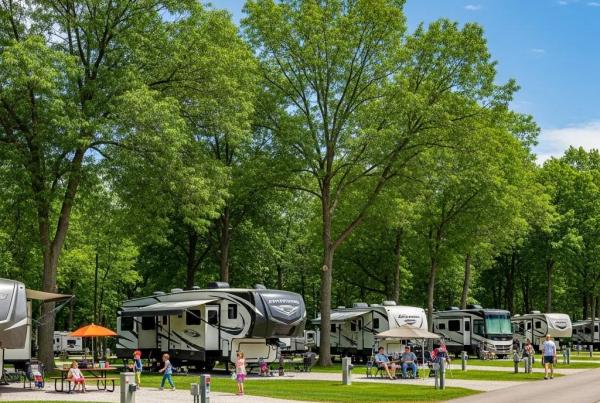

Full hookup camping means your campsite has three utility connections right at the pad: electric power, fresh water and a sewer connection. You plug in, hook up a hose and connect your sewer line, and your RV runs like a small house for the whole stay, with no trips to the dump station. A partial hookup site has one or two of those (usually water and electric), and an electric-only site has just the power pedestal.
Below is what each hookup type gives you, how 30-amp and 50-amp power differ, when a full hookup is worth paying for, and where to find the different site types at our two Michigan parks. Walnut Hills Family Campground in Durand has 80 full-hookup 50-amp sites; The Oaks Campground in Munith is water and electric (50 amp on short-term sites) with no sewer.
What does full hookup mean at an RV park?
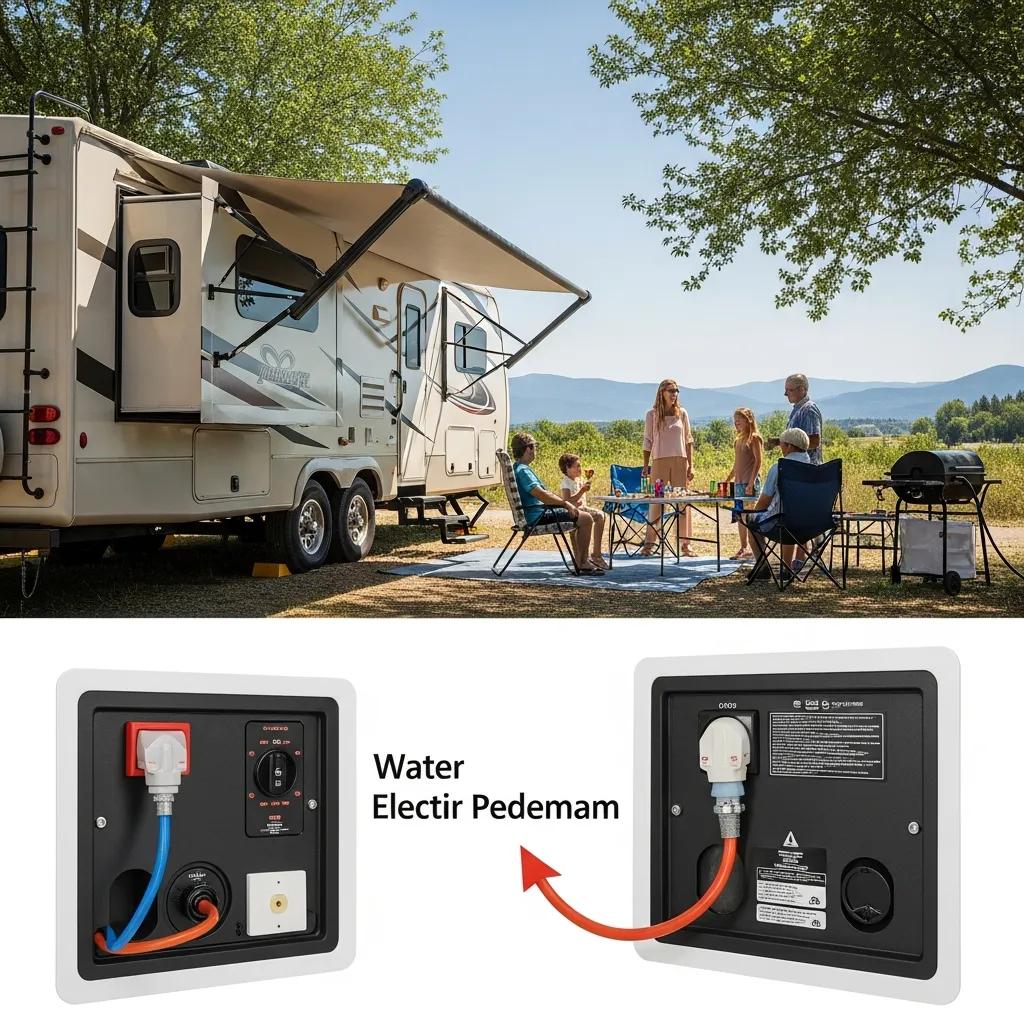
At most RV parks, “full hookup” (often written FHU) means all three of these connections are at your site:
| Connection | What it looks like | What it does |
|---|---|---|
| Electric | A pedestal with a 30-amp or 50-amp outlet, sometimes both | Runs the air conditioner, fridge, microwave, outlets and the converter that charges your batteries |
| Water | A threaded spigot you connect to with a drinking-water hose | Pressurized water for the sink, shower and toilet, so you don’t live off the fresh tank |
| Sewer | An in-ground sewer inlet, usually with a threaded cap | Lets you drain gray water (sinks and shower) and black water (toilet) from your site |
Most campgrounds also provide a picnic table and fire ring at every site, so those aren’t counted as hookups.
Full hookup vs partial hookup: what’s the difference?
The difference is the sewer connection. Here is how the common site types compare:
| Site type | Electric | Water | Sewer | Where the tanks go |
|---|---|---|---|---|
| Primitive (no hookups) | No | No | No | Dump station on the way out |
| Electric only | Yes | No | No | Fill the fresh tank at a spigot; dump station |
| Water and electric (partial) | Yes | Yes | No | Dump station, or a gray-water drain plus a honey wagon at some parks |
| Full hookup | Yes | Yes | Yes | Drains at the site |
For a weekend, a water-and-electric site works fine for most RVs. Your gray and black tanks hold two or three days of normal use, and you empty them at the dump station on the way home. A full hookup matters most when you’re staying a week or more, traveling with a big family that showers daily, or simply don’t want to think about tank levels.
What is a gray-water drain, and how does a honey wagon work?
Some campgrounds, including The Oaks and some seasonal sites at Walnut Hills, have a middle option: a gray-water drain at the site. Sink and shower water (gray water) runs into the drain, and only the toilet tank (black water) has to be pumped. A “honey wagon” is a pump-out truck or trailer that comes to your site and empties the black tank for a fee, so a long-stay camper never has to move the RV. Our team finds that a seasonal camper with a gray-water drain needs about six pump-outs a season, because nearly all of the water an RV uses goes down the gray drain. Pump-outs are $19 at all of our parks starting in 2027.
30 amp vs 50 amp: which does your RV need?
The two standard RV power services are very different in capacity:
- 30-amp service uses a three-prong plug on a single 120-volt line. That’s about 3,600 watts, enough for one air conditioner plus lights, the fridge and a few small appliances, but not all of them at once.
- 50-amp service uses a four-prong plug with two 120-volt lines, each rated at 50 amps. That’s up to 12,000 watts, which is why big rigs with two or three air conditioners, a residential refrigerator and an electric water heater need it.
Your RV’s shore-power cord tells you which one you have. A 50-amp rig can plug into a 30-amp pedestal with a “dogbone” adapter, but it only gets 30 amps, so you have to run one air conditioner at a time and stagger the microwave and water heater. A 30-amp rig can also adapt down to a 50-amp outlet without harm.
In practice, 50 amp is what separates a big-rig park from a standard one. At Walnut Hills, the full-hookup sites are 50 amp, and many sites run 70 to 80 feet long and take RVs up to 45 feet. The Oaks has 50 amp on short-term sites and 30 amp on seasonal sites, with no sewer at the site. Our campsite sizes guide explains how site length and width fit different rigs.

Campgrounds with electricity: what an “electric site” includes
If you’re searching for campsites with electric hookup, the listing usually means a pedestal with at least a 30-amp outlet and a standard 20-amp household outlet. Tent campers use electric sites for a fan, lights, a phone charger or an electric cooler. Here’s how it works at our parks:
- Walnut Hills: every one of the 201 RV sites has electric and water. Of the 18 tent sites, 4 have electric, across the road from sites 186 to 193 and near the main bathhouse; the rest are primitive.
- The Oaks: all RV sites are water and electric (50 amp on short-term sites, 30 amp on seasonal). Tent sites T1 to T12 have 20-amp electric, tent sites 178 and 179 have electric and water, and T13 to T18 are primitive, with no electric or water. Our team says The Oaks has arguably the nicest tent camping of our three parks, and the electric helps.
The two camping cabins at Walnut Hills have power and air conditioning, so a cabin is another way to camp with electricity without owning an RV.
Is a full hookup site worth it?
Full hookup sites cost more than water-and-electric sites at nearly every campground, including ours, because more people want them. Under dynamic pricing, a full-hookup, lakefront or riverfront site sits at the top of the range on any given date. Here’s how to decide:
- Worth it: stays of four nights or more, large families, big rigs that need 50 amp, anyone who works from the RV, and anyone who dislikes the dump-station line on Sunday morning.
- Skip it: one- or two-night weekends in a small trailer, tent camping, and stopover nights where you’ll dump on the way out anyway.
A campground employee put the stopover case plainly: “A pull-through site is generally designed for somebody just staying one night on the way through the area, so they don’t need a full hookup.” That’s why the pull-throughs at Walnut Hills (site 118 and sites 47 to 51) are water and electric rather than full hookup.
Our guide to average campground costs per night shows how much the sewer connection typically adds.
Full hookup camping at Walnut Hills
Walnut Hills has 80 full-hookup sites with 50-amp power, on a 42-acre park with 201 RV sites. When GatherGrounds took over in 2022, adding sewer and 50-amp service and rebuilding the power grid were the first big projects, done without taking out the old-growth trees that shade most of the park. Guests rarely comment on power that just works; they come back, and return-guest numbers have gone up every year since the rebuild.
A few places to look on the Walnut Hills map:
- The back fence line, sites 74 to 170B: full hookup with 30/50 amp and no neighbors behind you. A 30-foot band of old trees separates you from a farm field where deer graze most mornings. The larger lots in this row are the park’s premium sites.
- The north-end block, sites 186 to 193 and 171 to 178: two back-to-back rows of full-hookup sites next to the main bathhouse and across from Pavilion 2, the Kangaroo Jumper, the dog park, the gaga ball pit and the ball field. Groups like this block because the four electric tent sites are right across the road.
- The beach circle, sites 118 to 131: 30-amp water and electric, no sewer, with long, wide pads. Because there’s no sewer line to avoid, groups park sideways to form a ring with a shared open middle. Our team calls it “circling the wagons.”
Big rigs have no trouble turning in. The one tip from our team: don’t swing right into the parking lot by the store, which is sized for cars. Drive straight toward the gate, which you can see from the entrance, and the license-plate reader lets you through.
Rates are dynamic, so a full-hookup site costs more on a holiday weekend than on a Tuesday in June. RV sites start around the high $40s a night; see the Walnut Hills rates page for current numbers. For a statewide list of parks with sewer at the site, see our Michigan full hookup campgrounds guide.
Hookups at The Oaks
The Oaks is a 155-acre park with water-and-electric sites, a gray-water drain and honey-wagon service for black tanks. Short-term sites have 50 amp (seasonal sites are 30 amp), but there are no sewer hookups and no pull-throughs, so a 45-foot diesel pusher will be happier with a full hookup at Walnut Hills. What it has instead are the largest sites in either park, from 35 by 65 feet up to 55 by 120 feet, with no awning worries, plus 120 acres of trails. The team is looking at adding full-hookup sites in future seasons, but today there’s no sewer at the site, and we’d rather you know that before you book. Current ranges are on The Oaks rates page.
Frequently asked questions
What are the RV hookup types?
Electric only, water and electric (partial), and full hookup (electric, water and sewer). Electric comes as 30 amp, 50 amp or both. Some parks add a gray-water drain to water-and-electric sites.
Can I plug a 50-amp RV into a 30-amp site?
Yes, with a 50-to-30 adapter. You’ll be limited to about 3,600 watts, so run one air conditioner at a time and don’t start the microwave while the water heater is on electric.
What does “walk up” mean at a campground?
A walk-up site is first come, first served with no reservation; you show up and take an open site. Our parks are reservation-based: book online or by phone, and the gate opens for your license plate on arrival, with no office check-in. If you’re arriving after the store closes, call ahead to pre-check in.
Do seasonal sites have full hookups?
At Walnut Hills, seasonal sites are a mix of full sewer and gray-water-drain sites. At The Oaks, all seasonal sites are water, electric and gray-water drain with honey-wagon service. Power is metered monthly at both parks. See our seasonal campsites guide.