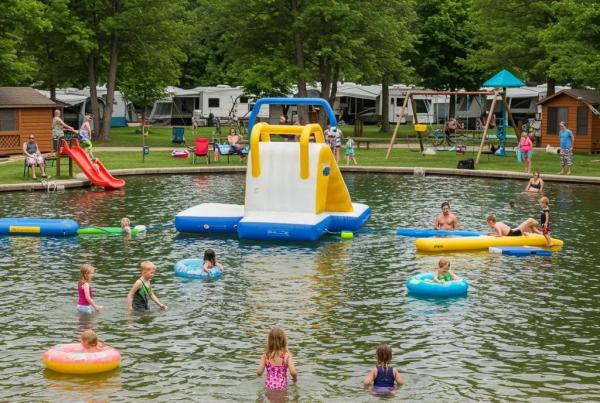
Full hookup campgrounds in Michigan are mostly private parks. A full hookup site has water, electric and a sewer connection right at the pad, and only about ten of Michigan’s 100-plus state park campgrounds offer them; most state park sites are electric and water with a dump station. In the southeast part of the state, Walnut Hills Family Campground in Durand has 80 full hookup sites with 50-amp power, sites long enough for 45-foot rigs, and a spring-fed lake and river to go with them. Our sister park, The Oaks in Munith, is a water-and-electric park (50 amp on short-term sites, 30 amp on seasonal) with a gray-water drain and honey-wagon service rather than sewer, so for full hookups in our family, Walnut Hills is the one to book.
Below: what counts as full hookup, where to find it in Michigan (state parks included), which Walnut Hills sites have sewer and which don’t, and how full hookup sites are priced.
What is a full hookup campsite?
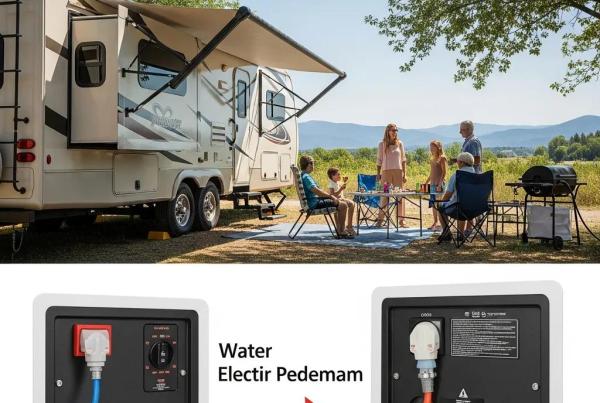
A full hookup RV site gives you three connections at the site: potable water, an electrical pedestal (30 amp, 50 amp or both) and a sewer inlet for your gray and black tanks. The sewer line is the part that separates it from a standard “water and electric” site, where you empty your tanks at the campground dump station on the way out. For a weekend, that difference is small. For a week, a family of five, or a seasonal site, sewer at the pad means long showers, dishes without watching the gray tank, and no dump-station line on Sunday. Our full hookup camping explainer goes deeper on the pros and cons.

Where are the full hookup campgrounds in Michigan?
Which Michigan state parks have full hookups?
The Michigan DNR has been adding full hookup loops, but they are still the exception. As of the most recent Detroit Free Press roundup, ten state parks offered full hookup sites: Aloha, Baraga, Hartwick Pines, Holland, North Higgins Lake, Orchard Beach, South Higgins Lake, Sterling, Wilderness and Wilson. Most of those are in northern Michigan; Sterling State Park in Monroe and Holland State Park are the exceptions downstate. Upgrades are planned or under way at Algonac, Bay City and Otsego Lake. State park sites also require a Recreation Passport for your vehicle. For the price picture, see our guide to Michigan state park campground rates.
Private full hookup RV campgrounds in Michigan
Private campgrounds supply most of the state’s sewer sites. Public parks are funded and priced differently (camping fees, the Recreation Passport and public capital investment) and offer fewer on-site amenities, while a private park pays for its sewer plant, 50-amp grid, amenities, staff and utilities through the site rate. The trade-off is a higher nightly price. What you get for it varies a lot from park to park, so the questions to ask are: how many sites are actually full hookup, what amperage they carry, how long the pads are, and what there is to do once you’re parked.
Full hookup RV camping at Walnut Hills, Durand
Walnut Hills has 201 RV sites on 42 acres, and 80 of them are full hookup with 50-amp service. GatherGrounds rebuilt the park’s utilities after taking over in 2022, adding sewer and 50-amp pedestals and replacing the power grid, and did it without clearing the old-growth trees that make the sites feel like campsites rather than a parking lot. A campground employee put the result this way: “Campers expect utilities that work, and now they do. What it results in is return customers, and our return-customer numbers have gone up every year since the renovations.”
Where the full hookup sites are, using the campground map:
- The north-end block, sites 186 to 193 and 171 to 178. Two rows of full hookup sites back to back, near the main bathhouse and across from the entertainment zone (Pavilion 2, the new playground, Kangaroo Jumper, dog park, gaga pit and ball field). This is the most popular area for groups and family reunions that want sewer, and four electric tent sites sit across the road for the tent campers in the party.
- The back fence line, sites 74 through 170B. Full hookup with 30/50 amp and no neighbor behind you. Behind the sites is a 30-foot band of old-growth trees, then a farm field where deer graze most mornings. The larger lots in this row are the park’s premium sites.
- Big rigs. Many Walnut Hills sites run 70 to 80 feet long and take RVs up to 45 feet, so the largest fifth wheels and Class As fit on many sites, not just a few. When you arrive, don’t turn into the parking lot, which is built for cars; drive straight toward the gate, which you can see from the entrance. See campsite sizes and layouts for what the dimensions mean.
Arrival is simple. There’s no office check-in: the gate reads your license plate, and after-hours arrivals call the store to pre-check in and drive straight to the site.
Which Walnut Hills sites are water and electric only?
Not every site has sewer, and some of the best-loved ones don’t:
- Pull-through sites 118 and 47 to 51 are water/electric. They’re meant for one-night stopovers, where sewer rarely matters.
- The beach area. Sites 104 to 117 along the beach and the circle across the road, 118 to 131, are 30-amp water and electric with no sewer. Because the utilities run down the back of each site, groups can park sideways at the front and “circle the wagons” around a shared open middle, something you can’t do on a sewer site without hitting the hookups.
Every site has a fire ring and picnic table, and the park has dump stations for the water/electric sites.
Campgrounds with electric hookups only: what you give up
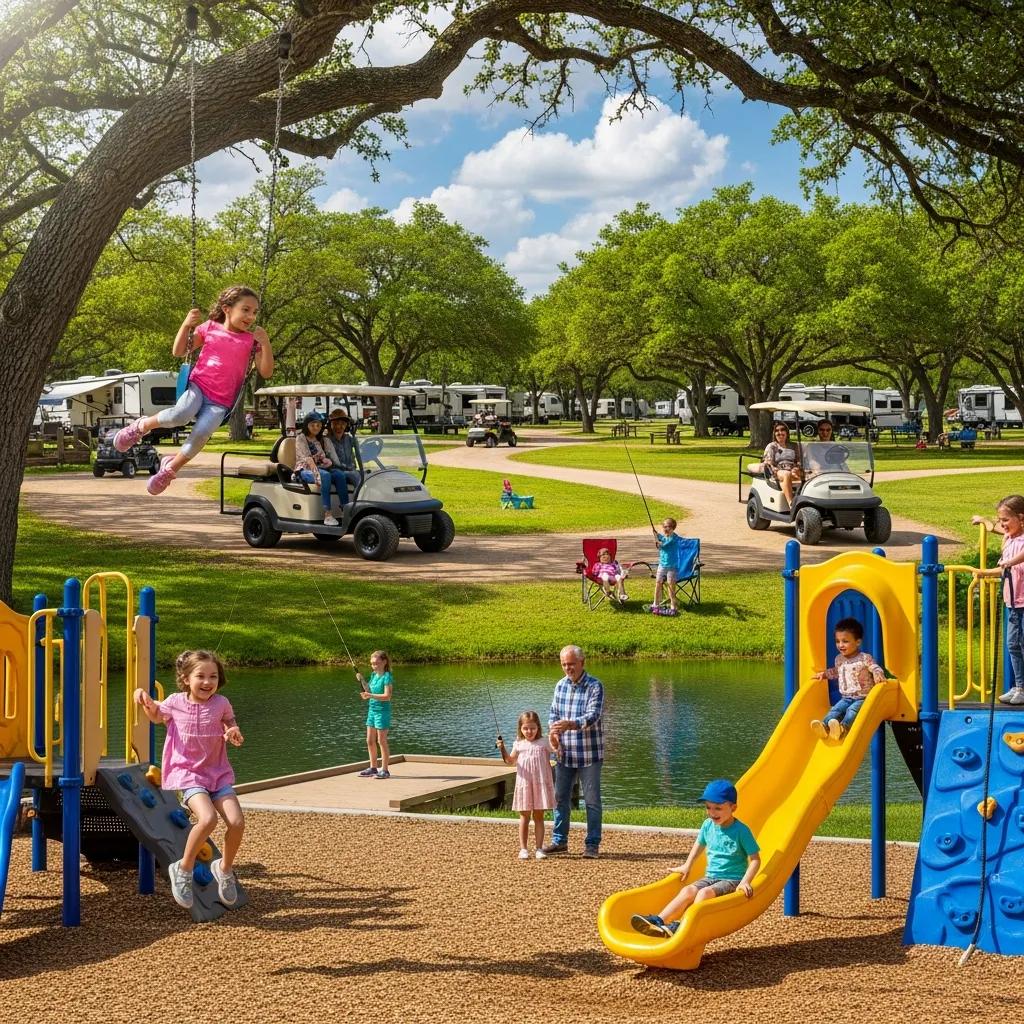
If a park is “electric and water” or “electric only,” you’ll use the dump station or, at some parks, a honey-wagon service that pumps your tanks at the site for a fee. That’s how The Oaks works: every site is water and electric (50 amp on short-term sites, 30 amp on seasonal) with a gray-water drain, so sink and shower water drains at the site and only the black tank needs pumping, about six times a season for a seasonal camper. Pump-outs are $19 each starting in 2027. The Oaks doesn’t have sewer at the site today, which is why big rigs that want a full hookup should book Walnut Hills. What The Oaks does have is the biggest sites of either park (35 by 65 feet up to 55 by 120) and 120 acres of trails; see The Oaks Campground if that’s your kind of trip.
Waterfront full hookup RV camping: what’s realistic
Searches for “waterfront full hookup 30 amp” usually end in a compromise, and here is how it works at Walnut Hills. The sites right on the beach are water/electric, not sewer. The river frontage sites (27 to 42) sit on the Shiawassee, close enough to launch a kayak from your site when the water is up; river view sites 1 to 26 look down on the river from 10 to 25 feet above it. If sewer is a must, the back-fence-line row gives you the open field and deer instead of water, and the beach is a short golf cart ride away. Ask the office which specific river sites have sewer before you book, because it varies.
30 amp vs 50 amp: which full hookup site do you need?
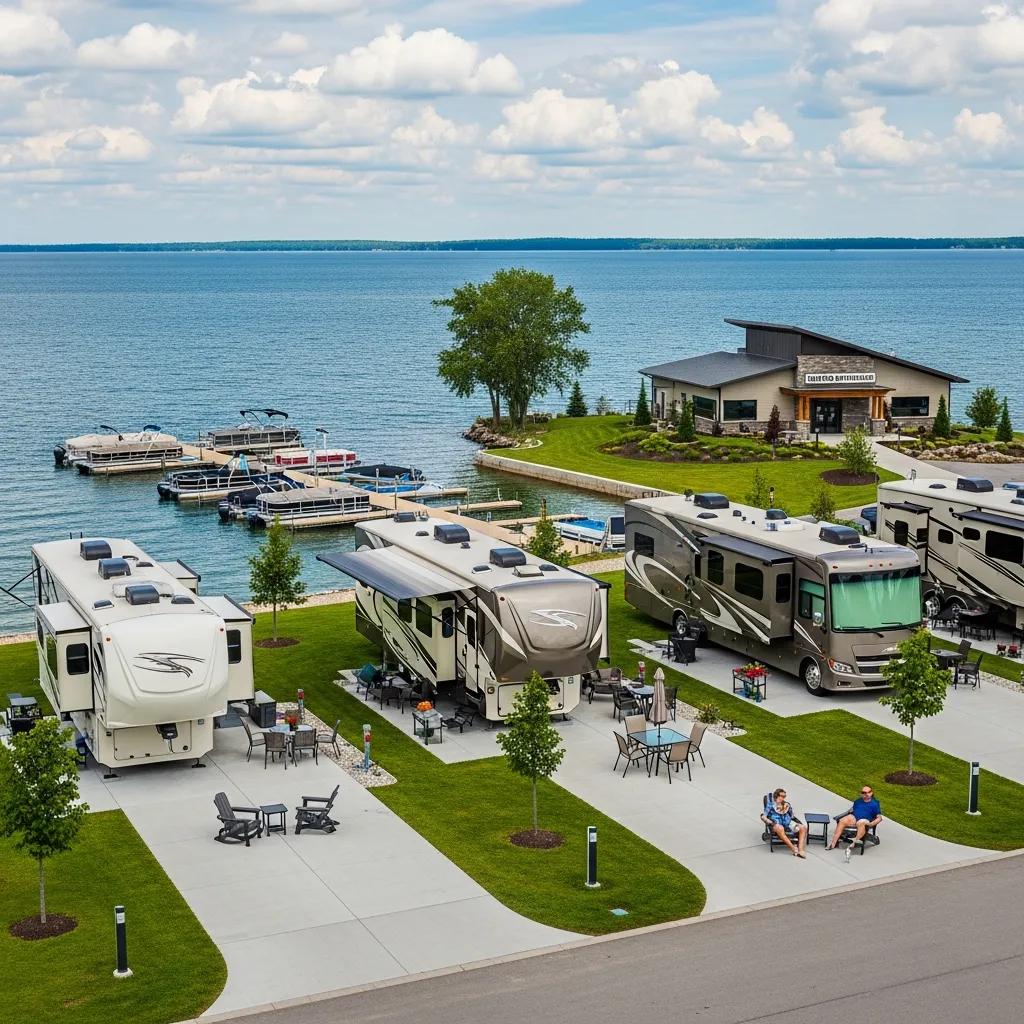
A 30-amp pedestal delivers about 3,600 watts; a 50-amp pedestal delivers about 12,000. One rooftop air conditioner, a microwave and a water heater will live on 30 amps if you don’t run them all at once. Two air conditioners, a residential fridge and an electric water heater want 50. Many Walnut Hills full hookup sites are 30/50, so either plug works. Bring a 50-to-30 adapter either way; it’s the cheapest piece of RV gear you’ll ever be glad you packed.
How much does a full hookup site cost in Michigan?
At Walnut Hills, RV sites start around the high $40s a night and change with the date and the site. Full hookup, lakefront and riverfront sites carry a premium because they book first, and holiday weekends cost the most. The same dynamic pricing works the other way on slow dates: May before Memorial Day, the weekend after Memorial Day, the weekends around Labor Day and October usually price below the base rate. Rates cover two adults and two children; extra adults are $13 a night and children 3 to 17 are $9. Current numbers are on the Walnut Hills rates page. Seasonal full hookup sites are also available; most of the 2027 seasonal availability is in the $3,000 to $4,000 range, with premium sites running up to $5,500. Details are on the seasonal sites page.
Frequently asked questions
Do any Michigan state parks have full hookup sites?
Yes, about ten, mostly in the northern Lower Peninsula and the U.P. Sterling State Park in Monroe is the main downstate option. Check the DNR’s reservation site for the specific loop, since only some sites in those parks have sewer.
Does The Oaks Campground have full hookups?
No. The Oaks has water and electric with gray-water drains and honey-wagon service, with 50 amp on short-term sites and 30 amp on seasonal sites. Full-hookup sites are at Walnut Hills.
Can I find year-round full hookup camping in Michigan?
Not at our parks. Both are open May 1 to October 20, and water lines at most Michigan campgrounds are shut off for winter. A handful of parks keep winter sites open; ask specifically about heated water connections if you plan to camp in the cold.
Are the pull-through sites at Walnut Hills full hookup?
No. Site 118 and sites 47 to 51 are pull-throughs with water and electric, designed for overnight stops. Full hookup sites are back-ins.