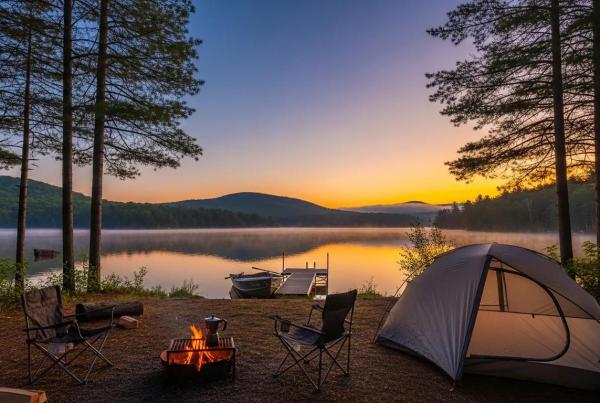

Seasonal campgrounds in Michigan rent you one campsite for the whole camping season, so your RV stays set up and you just drive out with the family and a cooler. GatherGrounds Resorts runs two of them in the southern Lower Peninsula: Walnut Hills Family Campground in Durand, the premium park on a spring-fed lake and the Shiawassee River, with 2027 seasonal sites at $3,000 to $5,500, and The Oaks Campground in Munith, a 155-acre nature park next to Waterloo Recreation Area, with 2027 seasonal sites at $2,500 to $3,300. Both run May 1 to October 20, bill power by the meter and store your camper on site free over the winter.
What is a seasonal campsite, and how does it work in Michigan?
A seasonal campsite is a single RV site leased for the full season instead of by the night. At both GatherGrounds parks the season is May 1 to October 20. The fee covers the site for those dates, plus a monthly electric bill for the power you use. Three things set this apart from membership-style parks:
- Your RV stays put. You don’t move it to a storage lot when you leave, as the membership model (two weeks on site, then into storage) requires. “All they have to do is grab their family and their food for the weekend and head to the campground in their car,” a campground employee says.
- Free winter storage. Returning seasonals, and new ones who sign up ahead of the season, leave the camper on the site over the off-season at no charge.
- Metered power. Every seasonal site is sub-metered and billed monthly, so a retiree who runs a fan isn’t paying for a neighbor’s two air conditioners.
Hookups differ by park. Walnut Hills has a mix of full-sewer seasonal sites and gray-water-drain sites. At The Oaks every seasonal site is water, electric and a gray-water drain. Gray-water sites use a honey-wagon pump-out for the black tank, about six times a season for most campers; pump-outs are $19 at all GatherGrounds parks from 2027.
Paying for a seasonal site
To hold your site for next year you renew with a deposit by October 1. The balance is split into six payments from November 1 to April 1, and about half of our seasonals simply pay in full in the fall. An online billing portal shows site payments and power bills and offers autopay. Sign up mid-winter and you catch up on the payments already due; after April 1 the season is paid in full; mid-season is prorated. For whether the fee pays off, see seasonal campsite costs in Michigan and seasonal vs nightly camping.

The best seasonal campgrounds in Michigan for families: two parks compared
We’ll leave ranking other parks to the review sites. What we can do is lay out our two side by side, because they suit different campers.
| Walnut Hills Family Campground | The Oaks Campground | |
|---|---|---|
| Location | Durand, between Flint and Lansing, just off I-69 | Munith, Jackson County, next to Waterloo Recreation Area |
| 2027 seasonal range | $3,000 to $5,500; most available sites $3,000 to $4,000 | $2,500 to $3,300; waterfront and larger sites at the top |
| Power and hookups | 30/50 amp; mix of full-sewer and gray-water-drain seasonal sites | 30 amp; water, electric and gray-water drain (honey wagon) |
| Water | Spring-fed swim lake with a 14-piece Wibit; the Shiawassee River and float trips | Spring-fed swim lake with a sand beach and Aquaglide water park; stocked fishing lake |
| Land | 42 acres, rolling hills, old-growth trees, river nature trail | 155 acres, about 120 of them trails for hiking, biking and golf carts |
| Site size | Standard to large; many 70 to 80 ft long | 35×65 ft up to 55×120 ft, the largest in either park |
| Events | Food trucks every weekend Memorial Day to September; three Halloween weekends | Holiday weekends, food trucks, DJ nights; one Halloween weekend |
| Best for | Water lovers and a resort-style stay | Nature lovers, grandparents, campers who want room |
Walnut Hills Family Campground, Durand: the premium seasonal park
Walnut Hills has 201 RV sites on 42 acres. GatherGrounds rebuilt the utilities after taking over in 2022, so there are 80 full-hookup 50-amp sites on a new power grid, a renovated bathhouse with private stalls, a store with scooped ice cream and an arcade, a new playground, a fenced dog park and the Kangaroo Jumper by Pavilion 2.
What makes a seasonal summer here different is the Wibit. The 14-piece floating water park is free for registered campers Tuesday through Thursday, so seasonal families who stay midweek have the lake almost to themselves. Weekends bring a food truck (always Saturday, often Friday dinner and Sunday breakfast), kids’ crafts at Pavilion 1 and a DJ, band or karaoke at Pavilion 2. The three Halloween weekends in September and October are the biggest draw of the year, and the seasonal site-decorating contest can produce nine winners.
Seasonal extras: campers with their own golf cart pay a $300 seasonal cart fee (it covers the park’s insurance; you also carry your own), and firewood can be delivered to your site. See the Walnut Hills seasonal sites page or call 989-634-9782. A tip from the team: “premium sites go first even though they cost more,” so the $3,000 to $4,000 band is where most of the current availability sits.
The Oaks Campground, Munith: nature, room and a lower price
If you’re searching for The Oaks Campground prices, a 2027 seasonal site is $2,500 to $3,300. GatherGrounds took the park over at the end of 2025 and spent its first season on a new sand beach (hundreds of tons of sand, treated water), the Aquaglide floating water park, a free Kangaroo Jumper and a renovated store. The roads and a new dock on the fishing lake are the next projects.
What you can’t build is the land. The drive in feels like leaving civilization, and the 120 acres of forest and grassland trails are, as far as our team knows, unmatched in southern Michigan. Sites run from 35×65 feet to 55×120 feet, far bigger than the industry’s roughly 33×60 standard; sites 46 to 61 are the largest with no rear neighbors, and sites 22 to 109 are the quiet old-growth section. Seasonals with boats store them on site free and use the Portage Lake public launch nine minutes away. Many Oaks seasonals are grandparents, and in fall the retirees drive a couple of corners over to the Haehnle Sanctuary viewing area to see thousands of sandhill cranes.
Short-term sites have 50 amp, but there’s no sewer, so a big rig that wants a full hookup belongs at Walnut Hills. Details are on The Oaks seasonal sites page, or call 517-596-2747.
Lakefront seasonal campgrounds in Michigan: what waterfront sites cost
Both parks have true waterfront seasonal sites, and both price them at the top of the range.
- Walnut Hills lakefront: sites 101 to 103 face the swim lake. River frontage is sites 27 to 42, right on the Shiawassee: “if you were nimble, you could launch a kayak or a canoe right from your site,” depending on water level. Sites 1 to 26 are river view, 10 to 25 feet above the water, and not priced as premium. The back fence line (sites 74 to 170B) is the other premium row: nobody behind you, a band of old-growth trees and a farm field where deer graze every morning.
- The Oaks lakefront: the lakefront RV sites are a short walk from the beach with a view of the Aquaglide. These and the largest lots are the $3,300 end of the Oaks range.
Waterfront sites renew at the highest rate of any sites, so ask to be called the moment one opens.

Seasonal campgrounds near Detroit, Flint, Lansing, Ann Arbor and Jackson
If you’re searching “seasonal campground near me” from Southeast or Mid-Michigan, geography decides it. Walnut Hills draws its seasonals from Flint and Genesee County, Lansing, the Saginaw, Bay City and Owosso corridor, and Detroit’s north suburbs in Oakland and Macomb counties (see campgrounds near Detroit). The Oaks draws from Jackson, Ann Arbor, Lansing and the Detroit metro, with Chelsea, Dexter and the Irish Hills close by (see campgrounds near Jackson). Neither park is in West Michigan. For a seasonal site, closer is better: seasonals who live within an hour come out midweek, not just weekends.
Seasonal site rules in Michigan: sheds, decks, campers and lawns
Michigan regulates campgrounds through EGLE, and its rules are written to keep campgrounds places for vacationing. They also keep every row looking cared-for, which is part of what you’re paying for:
- Sheds up to 99 square feet. A 12×8 shed is fine; a 10×10 is not.
- Decks up to the camper’s footprint (a 30×8 camper can have a 30×8 deck), never attached to the RV, which has to be able to leave the site in an emergency.
- No mailboxes and no rooms built onto campers, under state law and fire code.
- Campers 15 years old or newer with no exterior damage, washed and clean. Older units can be submitted for review; a restored Airstream is welcome.
- Lawns stay mowed. Site upkeep standards keep the whole park looking cared-for. Borrow a mower from the store, trade weekends with your neighbor (very common), or opt into the staff lawn program at $65 a month for the whole season.
- Visitors register at the store and pay a day, swim-area or overnight rate, because the state caps headcount per site and per campground; it’s also how we know who is in the park. Someone on the camping agreement is present whenever the site is in use.
- Quiet hours 11 PM to 8 AM, so your kids actually sleep; kids and bikes back at the site by dusk; golf carts parked at dark; firewood from the store (Michigan asks that outside firewood stay home); no fireworks.
The point of all of it, our team says, is that families “feel comfortable letting their kids roam freely throughout the campground without worry.” Posted rules are on each park’s map page, for example Walnut Hills map and rules.

How does a seasonal site compare with Michigan state park rules?
Michigan state park campgrounds don’t offer seasonal sites. During peak season (May 15 to September 15) the DNR caps a stay at 15 nights, and you need a 5-night break before returning to the same park. That keeps public campgrounds open to everyone, and it’s why a family that wants the same site all summer ends up at a private seasonal campground. State parks also cost less per night: public parks are funded and priced differently (camping fees, the Recreation Passport and public capital investment) and offer fewer on-site amenities, while a private park pays for its water park, events, bathhouses, staff and utilities through the site rate. See Michigan state park campground rates for the numbers.
When do Michigan state parks close for the season?
Most state park campgrounds take reservations from early or mid-May through mid-to-late October, with modern restroom buildings often open only mid-May to mid-October. A handful run longer or year-round with reduced services; the DNR’s operating-dates page lists each one. Our seasonal access runs May 1 to October 20, which includes the quiet fall-color weeks of October.
Are there year-round campgrounds in Michigan?
A few private parks and a handful of state park campgrounds stay open through winter, but most Michigan campgrounds, ours included, are three-season: May 1 to October 20. A seasonal site isn’t year-round living, and by state law a campground can’t be your residence. What you get is a camper that stays on its site twelve months a year and is ready when the gates open in May. For true year-round or long-term options, see long-term camping in Michigan; for a month or more without a seasonal commitment, The Oaks offers monthly rates (25% off nightly on non-beachfront sites, 30-night minimum).
What a seasonal summer actually looks like
Most seasonals come out on weekends, when the events and food trucks run. Some stay all summer: a teacher and the kids live at the campground while the other parent commutes from the site. At Walnut Hills the free Wibit weekdays now bring short-term families in midweek too, so “the seasonal families who are out there on the weekdays get to meet new people all the time.”
One policy shapes the community more than any amenity: GatherGrounds doesn’t fund seasonals-only events. Seasonals who want to host something, a karaoke night at the pavilion, say, get the pavilion free as long as every camper is invited. “We’re all in this together,” our team says, “and everybody that comes to our campgrounds is trying to achieve a pretty similar outcome: relaxation and making memories with their families.” Those camper-hosted events grew all season at Walnut Hills in 2026, and a few returning seasonal families told us they came back because their kids had more fun here.
Can I bring my dog to a seasonal site?
Yes, at both parks, with no breed restrictions; we just ask that your dog be friendly with people and other dogs. At Walnut Hills, dogs stay leashed except inside the fenced quarter-acre dog park, which has shade, picnic tables, tunnels and a real fire hydrant, and they can swim in the Shiawassee by the boat launch (not in the swim lake or at the beach). At The Oaks, dogs can run off leash on the back trails and in the dog run at the front of the park (fencing planned) and swim in the fishing lake, though not at the swim beach; everywhere else they’re leashed. Dogs stay out of the stores at both parks. More in our guide to Michigan campgrounds with dog parks.
Frequently asked questions
How much does a seasonal campsite cost in Michigan?
At our parks, $2,500 to $3,300 at The Oaks and $3,000 to $5,500 at Walnut Hills for the May 1 to October 20 season, plus metered electric. Winter storage is free.
When should I sign up for a seasonal site?
Returning campers renew by October 1, so new availability shows up in October. Sign up any time over the winter and catch up on the payment schedule; after April 1 the season is paid in full.
Which park is more of an RV resort?
Walnut Hills: full hookups, 50 amp, a renovated bathhouse and the Wibit. The Oaks is a more traditional camping experience with big sites, trails and a beach, at 30 amp with a gray-water drain.