How Campground Brokers Figure Out What Your Property Is Worth
Your campground’s market value is essentially what a ready buyer would pay, based on its earning potential, physical assets, and current market conditions. Brokers use structured methods to turn these factors into a concrete offer. This guide breaks down how they determine value—covering income-based methods like Net Operating Income (NOI) and capitalization rates (cap rates), comparable sales, and cost approaches, plus revenue-based multipliers. Our goal is to demystify these valuation steps so you can see the mechanics behind the numbers and actively improve your outcome. Many owners feel that valuations are a mystery or solely driven by broker interests. By clearly explaining the calculation steps and key drivers—like location, amenities, occupancy, condition, and growth potential—this guide addresses that concern with practical examples. You’ll find step-by-step NOI and cap-rate calculations for quick estimates, checklists to get your financials and property in top shape, comparison tables of valuation methods, and the latest 2025 market insights. Read on for actionable advice you can use to present cleaner financials, negotiate more effectively, and explore options like direct sale offers from family buyers.
What Are the Main Ways Brokers Value Campgrounds?
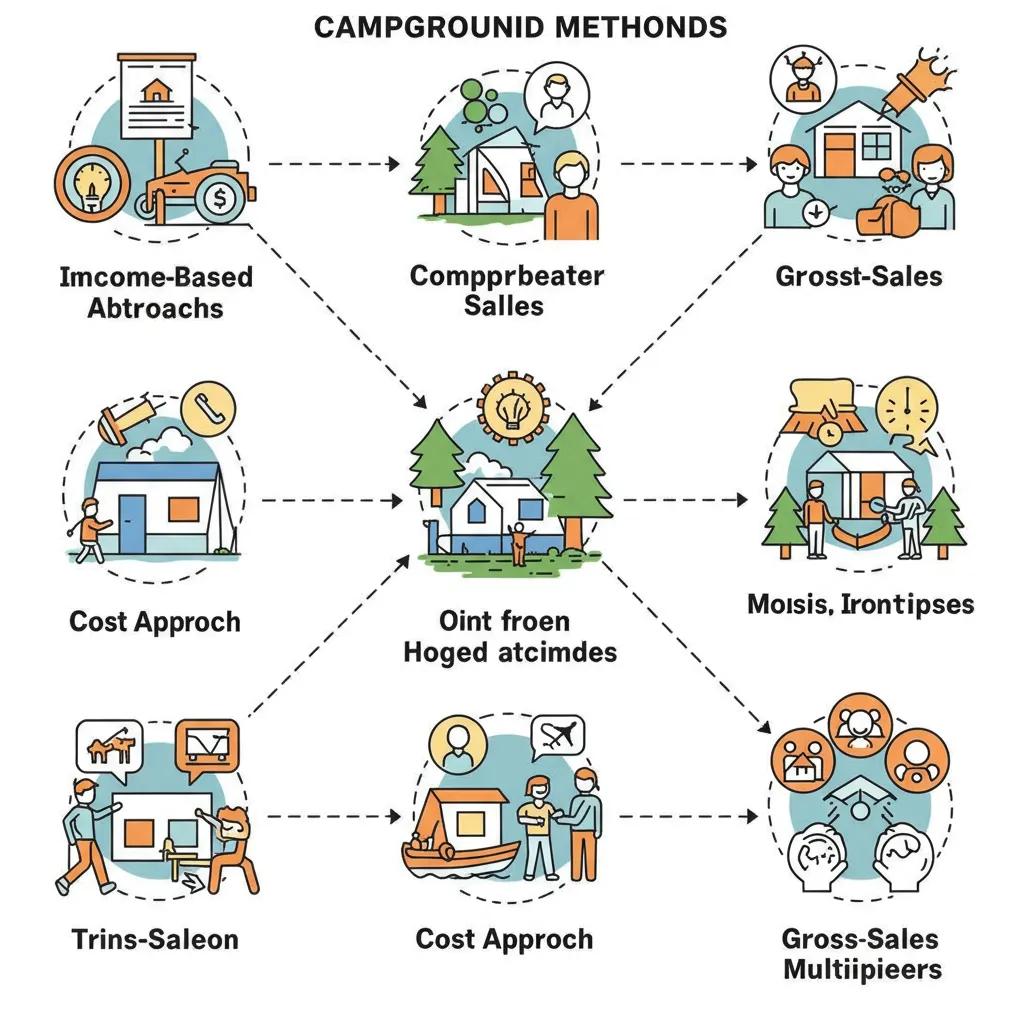
Brokers primarily use income-based approaches, comparable sales, the cost approach, and gross-sales multipliers. Each method translates different inputs into value, considering the underlying mechanism, risk, and available data. Income approaches leverage Net Operating Income (NOI) and a chosen capitalization rate to convert ongoing earnings into a present value, which is particularly beneficial for owners with stable revenue. Comparable sales benchmark value against recent transactions of similar campgrounds or RV parks, with adjustments for site count and amenities. These are most useful when there’s healthy transaction activity. The cost and replacement approaches calculate value based on land plus the cost to rebuild improvements, often applied to newer developments or when comparable sales are scarce. Gross-sales multipliers use historical revenue as a quick indicator in specific markets.
Brokers typically balance these methods based on the property type and the data available. They then weigh each approach to arrive at a reconciled value estimate that reflects market realities and buyer interest. The table below offers a quick comparison of these methods, their main inputs, and their typical impact on price.
Different valuation methods rely on distinct inputs and show varying sensitivities to revenue, expenses, and physical improvements.
How Do You Calculate Net Operating Income for a Campground?
Net Operating Income (NOI) represents the recurring operating profit a campground generates before accounting for debt service and taxes. It’s calculated by subtracting operating expenses from gross operating income and is the cornerstone of income-based valuation. To figure out your campground’s NOI, tally up all revenue sources—site fees, cabin rentals, store and concession sales, amenity rentals, and any extra services. Then, deduct recurring operating expenses like payroll, utilities, maintenance, supplies, insurance, property taxes, and management fees. Crucially, sellers must exclude one-time capital expenditures, owner personal expenses, and extraordinary nonrecurring costs to present an adjusted NOI that accurately reflects normal operations.
Presenting NOI clearly and with supporting documentation reduces buyer adjustments during due diligence and directly boosts your value, as buyers will capitalize that income with a cap rate. Understanding how brokers scrutinize each line item prepares you to document and justify adjustments during negotiations, leading to a faster, smoother valuation process.
What’s the Role of the Capitalization Rate in RV Park Valuations?
The capitalization rate (cap rate) is used to convert a property’s NOI into an estimated value using the formula: Value = NOI ÷ Cap Rate. It acts as a market-driven measure of the required return and perceived risk. Cap rates reflect prevailing interest rates, asset risk, location quality, and market liquidity. Lower cap rates generally indicate higher valuations for the same NOI, while higher cap rates reduce the property’s value.
Selecting the right cap rate involves comparing similar asset sales, assessing market demand and growth prospects, and considering property-specific risks like deferred maintenance or concentrated revenue streams. Brokers use their judgment, market comps, and buyer feedback to determine a cap rate that best reflects current market conditions.
How Do Comparable Sales Affect Campground Market Value?
Comparable sales offer a market-anchored benchmark by using prices paid for similar properties in a relevant geographic area and timeframe. Brokers then adjust these comparables to account for differences in site count, amenities, revenue mix, and overall condition. When good comps are available, they help validate or challenge income-based estimates and can quickly signal the price ranges buyers are willing to consider. However, comparable sales can be limited in markets with low inventory or when transaction details (like NOI or cap rate) aren’t publicly disclosed, forcing brokers to make larger adjustments or rely more heavily on income or cost approaches.
Brokers will weigh comps based on how recent they are, their location similarity, and the property size. They often reconcile the value derived from comps with income-based values to create a final valuation opinion that considers both earnings potential and market sentiment.
What Is the Cost Approach, and How Are Gross Sales Multipliers Used?
The cost approach estimates value by adding the land value to the replacement cost of improvements, then subtracting depreciation. This method is particularly suitable for newer parks, specialized facilities, or situations where income history is limited. It’s less tied to operating performance and more to construction and land economics, often providing a floor value in negotiations. Gross sales multipliers are a revenue-based shortcut that multiplies annual gross receipts by an industry-specific multiplier to arrive at an indicative price. These multipliers vary by market and revenue stability and are useful for quick screening or when NOI data is unavailable.
Each method has its advantages and disadvantages: the cost approach offers objectivity for improvements, while sales multipliers are fast but less precise. Brokers often combine methods to cross-check valuations and present a well-supported range to sellers and buyers.
What Key Factors Influence Your Campground or RV Park’s Market Value?
Several attributes beyond valuation methods—including location, amenities, financial performance, property condition, and growth potential—significantly influence what buyers will pay. This is because buyers underwrite risk, revenue stability, and potential upside when evaluating offers. Location dictates demand drivers like proximity to attractions, regional tourism trends, and drive-time markets, all of which impact occupancy and seasonal revenue. Amenities and operational systems influence guest willingness to pay and drive ancillary revenue; enhanced amenities often boost both occupancy and average daily rates.
The checklist below helps owners self-assess the factors buyers prioritize and where to focus pre-sale improvements.
- Location Quality: Proximity to attractions and accessibility for target guests.
- Stable Financial Performance: Consistent NOI and diversified revenue streams.
- High-Value Amenities: Hookups, bathhouses, water features, and recreational assets.
- Infrastructure Reliability: Adequate water, septic, electrical systems, and roadways.
- Expansion Potential: Land or approvals for additional sites or amenities.
Reviewing this checklist can identify areas where modest investments or operational adjustments can meaningfully improve marketability and sale price.
How Does Location Impact Campground and RV Park Valuation?
Location influences valuation by shaping demand, seasonality, and guest demographics. Destination parks near lakes or national parks attract travelers willing to pay a premium, while drive-to markets rely on local weekend demand and may have different occupancy patterns. Buyers assess regional tourism trends, access routes, and nearby competing properties to forecast occupancy and rate potential. Seasonality also plays a role: parks in climates with shorter seasons face higher revenue volatility and may trade at higher cap rates to compensate for that risk.
Understanding your park’s market position helps tailor marketing, operations, and valuation expectations. Effective location analysis naturally leads to optimizing amenities and revenue mix to match local demand patterns.
What Amenities and Features Boost Campground Market Value?
Amenities that increase market value include reliable full hookups, modern bathhouses, rentable cabins, water-based recreation, expanded Wi-Fi for long-stay guests, and an on-site store or café that drives ancillary income. Operational systems like an online reservations platform and efficient staffing models also improve revenue capture and reduce friction for guests, enhancing conversion and repeat stays. Buyers often rank utility upgrades and renovated guest facilities as high-ROI investments because they reduce buyer capital expenditures and improve immediate revenue potential.
Prioritizing amenity investments that align with your target guest profile—for example, premium sites and hookups for RV travelers or upgraded bathhouses for family resorts—tends to yield the best return on investment and directly supports income-based valuation approaches.
How Do Financial Performance and Occupancy Rates Affect Valuation?
Financial performance and occupancy rates are primary indicators of NOI stability. Steady year-over-year occupancy, diversified revenue streams (site fees, rentals, store income), and predictable peak-season performance reduce perceived risk and can justify a lower cap rate. Brokers annualize and smooth seasonal income to present a normalized NOI, and they scrutinize trends across multiple years to validate sustainability. High variability or declining occupancy will prompt larger buyer discounts or contingency reserves in offers.
Demonstrating diversified, repeatable revenue streams and providing documented occupancy and booking histories increases buyer confidence and reduces valuation adjustments during due diligence.
Why Are Property Condition and Infrastructure Crucial in Valuation?
Property condition and infrastructure determine near-term capital needs and operational risk. Buyers evaluate roads, electrical capacity per pad, septic and sewer capacity, water supply reliability, and any erosion or environmental issues. Deferred maintenance or outdated utilities typically result in offer discounts or larger escrow holdbacks because buyers must underwrite repair costs. Conversely, recently upgraded systems reduce buyer uncertainty and can be capitalized into a higher immediate offer.
Addressing major infrastructure liabilities before marketing or documenting accurate repair scopes helps preserve value and speeds transaction timelines by removing negotiation friction.
How Does Growth Potential and Expansion Opportunity Influence Value?
Growth and expansion potential—such as additional buildable pads, untapped acreage, permitted cabin sites, or rezoning possibilities—add quantifiable upside that buyers capitalize into offer prices through pro forma revenues and cost-per-pad analysis. Buyers evaluate entitlement risk, site grading and utility extension costs, and realistic absorption rates for new sites when determining how much premium to pay. When upside is credible and supported by local market demand, buyers may accept higher valuations reflecting future revenue streams.
Articulating expansion assumptions with conservative pro formas and cost estimates makes it easier for buyers to validate upside and can significantly increase negotiation leverage.
How Can Campground Owners Prepare Their Property for a Successful Valuation and Sale?

Preparation involves financial transparency, expense optimization, targeted capital improvements, and organized documentation to reduce buyer risk and maximize sale proceeds. Brokers and buyers expect multiyear financials, occupancy and reservation logs, inventory and site maps, vendor contracts, and clear records of capital projects. Cleaning up financials means removing personal expenses, documenting nonrecurring repairs separately, and presenting a normalized P&L that reflects sustainable operations. Property improvements should prioritize high-ROI items like bathhouse upgrades, utility pad expansion, and reservation systems that immediately enhance revenue capture.
Below is a table showing common financial statement line items, how brokers typically adjust them, and example adjustments owners can prepare ahead of listing to minimize post-offer reclassification.
What Financial Documents Should You Organize Before Selling?
Assemble a due diligence package that includes at least three years of P&L statements, tax returns, detailed occupancy and reservation reports, site maps and pad inventories, vendor and contractor agreements, utility bills, and proof of permits or zoning approvals. Brokers and buyers use these documents to validate revenue, assess expense trends, and identify contingent liabilities that could affect offers. Presenting organized, corroborated documents reduces perceived risk, shortens due diligence timelines, and supports the adjusted NOI used in valuation.
How Do You Adjust Expenses to Maximize Net Operating Income?
Adjusting expenses to maximize NOI involves removing non-operational or discretionary owner expenses, reclassifying one-time capital repairs, and documenting any extraordinary events separately from recurring operations. Common adjustments include removing owner personal expenses (vehicles, personal insurance), excluding nonrecurring capital projects from operating expenses, and aligning management or related-party fees to market comparables. Supporting each adjustment with invoices, contracts, and clear narratives makes them credible to buyers and reduces the likelihood of aggressive post-offer reductions.
A mini before-and-after NOI example—properly reconciled and documented—helps buyers accept adjusted figures and improves the reliability of income-based valuations.
Which Property Improvements Can Increase Your Campground’s Market Value?
Target improvements that lower buyer capital needs and increase revenue, such as upgraded bathhouses, expanded utility capacity for premium pads, cabin or glamping unit additions, improved roadways, and an on-site retail or food amenity that boosts ancillary revenue. Prioritize projects with clear short-term payback or those that directly reduce buyer capital expenditure forecasts. Smaller cosmetic investments—landscaping, signage, and site-level upgrades—also enhance perceived value and marketability and can shorten sale timelines.
Selecting improvements that align with buyer demand in your region ensures that capital invested before sale translates into higher offers and fewer negotiated credits at closing.
How Does Proper Documentation Impact Buyer Confidence and Pricing?
Proper documentation reduces perceived transaction risk by allowing buyers to quickly verify claims, which can lower contingencies and increase offer prices. Missing or inconsistent records commonly cause diligence delays, larger escrows, or price reductions as buyers build in asymmetric risk premiums. Providing an organized pre-listing due diligence packet with supporting schedules for NOI adjustments, utility capacity reports, and site documentation accelerates offers and often results in stronger pricing because buyers can underwrite with confidence.
A tidy documentation package also enables smoother negotiation over qualifying adjustments and helps preserve net proceeds by minimizing post-offer reductions.
What Is the Role of Campground Brokers and How Do They Assess Your Property?
Campground brokers act as market intermediaries who compile market comps, prepare marketing materials, vet buyer qualifications, and negotiate terms. They perform valuation assessments by combining income, sales comparables, and cost analysis. Brokers add value by providing broad market exposure, specialized buyer networks, and marketing sophistication, which can increase the pool of potential buyers and competitive tension, potentially leading to higher sale prices. Brokers typically charge commissions, which owners weigh against the potential pricing benefit and reduced transaction management burden.
Understanding the broker process—how they source comps, conduct site visits, and present valuation memos—helps owners decide whether engaging a broker or pursuing a direct sale better aligns with their objectives.
When Should You Hire a Campground Broker to Value Your Property?
Owners should consider hiring a broker when they need broad market exposure, when the property is complex (multiple revenue streams or entitlements), or when they prefer a marketing-driven sale to maximize price. Brokers are also valuable when competition among buyers can be cultivated to push pricing. However, for sellers prioritizing a quick, low-stress transition or legacy preservation over maximizing price, direct sales to qualified family-owned buyers can be attractive. Evaluating your goals—speed, price, privacy, or legacy preservation—helps determine if brokerage services are worth the commission.
This decision framework naturally leads into how brokers conduct market and property analysis.
How Do Brokers Conduct Market Analysis and Property Assessments?
Brokers perform market analysis by collecting regional sales data, contacting known buyers, completing on-site inspections, and reviewing multiyear financial performance to produce valuation memos or offering memoranda. They request detailed documents—P&Ls, occupancy ledgers, site maps, and capital expenditure histories—to validate revenue streams and identify deferred maintenance that could alter underwriting. Brokers then reconcile income, sales comparables, and replacement cost approaches to present a recommended listing range and marketing strategy tailored to the asset.
Knowing what brokers will ask for enables owners to prepare materials that support higher valuations and a smoother sale process.
What Are the Alternatives to Using a Broker, Including Direct Sales?
Owners can pursue three primary sale paths: sell with a broker, self-list, or pursue a direct sale to an acquisition buyer. Each approach has trade-offs: brokered sales typically offer broader exposure and marketing but incur commissions and longer timelines; self-listing saves fees but requires owner bandwidth and may reduce exposure; direct sales can be faster, reduce complexity, and may better preserve the park’s legacy depending on the buyer. Sellers prioritizing legacy preservation and low-pressure transitions may find direct buyers preferable, while those seeking maximum market price often choose brokerage-driven processes.
A concise comparison clarifies the decision criteria for owners evaluating alternative sale paths.
How Does GatherGrounds Resorts Approach Campground Acquisition Differently?
GatherGrounds Resorts is a family-owned company that positions itself as a thoughtful direct buyer alternative to large institutional buyers and broker-driven sales, emphasizing trust, care, and commitment to preserving a campground’s legacy. Their stated focus is on acquiring existing campground properties, particularly those with over 130 sites, with an emphasis on maintaining traditions and the existing team where possible. GatherGrounds highlights direct buyer relationships and low-pressure initial conversations so owners can explore retirement or sale options without the stress of extended marketing campaigns.
For owners whose priority is a respectful transition that preserves family and guest traditions, GatherGrounds’ campground acquisition service offers a direct-sale pathway that can be evaluated alongside brokered options.
What Are the Current Market Trends and Industry Insights Affecting Campground Valuations in 2025?
In 2025, the campground and RV park sector continues to be shaped by strong leisure demand, limited inventory, and evolving buyer preferences, all of which impact cap rates, pricing, and underwriting assumptions. Cap rates commonly observed in 2025 range between 7% and 10%, with lower rates for well-located, stabilized assets showing consistent NOI and higher rates for assets with shorter seasons or deferred capital needs. Demand remains relatively strong as buyers seek income-producing, lifestyle assets with predictable cash flow and value-add prospects. Limited inventory in many regions creates competitive dynamics that can further compress cap rates for premium properties, while less desirable assets face wider yield demands.
What Are Typical Cap Rates and Market Demand Conditions for RV Parks in 2025?
Typical cap rates in 2025 for RV parks generally fall within the 7%–10% range. Lower rates are seen for well-located, stabilized assets with consistent NOI, while higher rates apply to assets with shorter seasons or deferred capital needs. Interest rate fluctuations also play a role: as general borrowing costs rise, cap rates tend to adjust upward to maintain spread. The recent high-interest-rate environment (2023–2024) has put upward pressure on RV park cap rates in some instances, although robust demand and income growth have partially offset this.
Demand remains relatively strong as buyers seek income-producing, lifestyle assets with predictable cash flow and value-add prospects. Limited inventory in many regions creates competitive dynamics that can further compress cap rates for premium properties, while less desirable assets face wider yield demands.
These cap rate signals guide owners on reasonable valuation expectations and inform decisions about pre-sale investments aimed at shifting buyer perception toward lower perceived risk.
How Are Remote Work and Long-Term Stay Trends Impacting Valuations?
Remote work and long-term stay trends are increasing demand for sites capable of supporting extended stays, leading to more stable, predictable revenue streams that buyers value. Parks offering enhanced Wi-Fi, reliable utilities, private work-friendly site configurations, and long-term pricing structures can capture higher occupancy months and attract long-term guests whose spending patterns stabilize NOI. Buyers increasingly model a portion of revenue as recurring long-term stays, which can justify lower cap rates due to enhanced cash-flow predictability.
Why Is Sustainable Infrastructure Increasing Campground Value?
Sustainable infrastructure—such as energy-efficient lighting, wastewater improvements, and solar or water-saving systems—reduces operating costs, mitigates environmental risk, and can attract eco-conscious guests willing to pay a premium. Buyers recognize that lower utility and maintenance costs improve NOI and reduce future capital outlays, effectively increasing net present value. Additionally, sustainable features may unlock regulatory benefits or community goodwill that support long-term operations and marketability.
How Does Digital Marketing Influence Campground Sales and Valuation?
Digital marketing and robust direct-booking systems improve occupancy and average revenue per booking by reducing reliance on third-party channels and enhancing conversion rates, which buyers track as KPIs during underwriting. A strong online presence, integrated reservation systems, and measurable direct-booking revenue streams increase revenue capture and signal operational competence to buyers. Brokers and buyers often request digital performance metrics, including direct booking percentages, website conversion rates, and channel cost breakdowns, when assessing value.
How Do You Estimate Your Campground’s Market Value Quickly and Accurately?
Quick estimates rely on practical rules of thumb, a fast NOI calculation, and selecting a defensible cap rate to convert NOI into an indicative value. This process offers a starting point for deeper appraisal work. Common heuristics include price per pad or revenue multiples, but these rules vary widely by region and should be used cautiously. A faster, more reliable method uses adjusted NOI and an assumed cap rate: calculate normalized NOI from recent operations, choose a market-appropriate cap rate based on asset quality and 2025 market context, then divide NOI by that cap rate to get an estimated value. The worked example below demonstrates this approach.
For owners who want a rapid, reliable assessment, GatherGrounds’ campground acquisition service can provide a no-pressure preliminary valuation conversation to validate quick estimates and discuss direct-sale options.
What Are the Common Rules of Thumb for RV Park Valuation?
Common rules of thumb include price-per-pad ranges and gross revenue multiples, which vary by region and asset quality. For instance, price-per-pad can vary widely depending on site type (basic vs. premium) and location, while gross revenue multipliers offer a quicker, less precise screen. These heuristics are useful for initial screening but can be misleading when revenue mix, occupancy variability, or significant capital needs exist. Owners should pair rules of thumb with income-based calculations for a more defensible estimate.
Using rules of thumb as an initial sanity check helps identify whether a deeper income-based valuation is warranted.
How Can You Use NOI and Cap Rate for a Fast Valuation Estimate?
To estimate value quickly, compute a normalized NOI (e.g., $250,000) and select a market cap rate reflective of 2025 conditions and asset risk (e.g., 8%). Apply the formula: Value = NOI ÷ Cap Rate. So, $250,000 ÷ 0.08 = $3,125,000. Adjust the cap rate up or down based on property condition, demand, and growth prospects to see a valuation range. This step-by-step method gives owners a defensible starting point for pricing expectations and negotiation planning.
After performing a quick calculation, owners who want confirmation or a professional review can request a no-pressure conversation with GatherGrounds to discuss a fast, reliable assessment using their campground acquisition service.
What Tools and Resources Are Available for Campground Valuation?
Useful tools for valuation include spreadsheet NOI models, industry comp databases, broker valuation memos, and online calculators for rough estimates. Industry associations and commercial platforms can supply comps and market context. Owners should use a spreadsheet to model multiple scenarios, track adjustments, and produce a reconciled valuation range. For more precise outcomes, consult brokers, appraisers, or experienced direct buyers who can validate assumptions and provide competitive offer feedback.
Knowing when to escalate from DIY estimates to professional valuation services helps owners balance cost, speed, and accuracy in sale planning.
Frequently Asked Questions
What Should Campground Owners Know About Market Trends in 2025?
In 2025, campground owners should be aware of strong leisure demand, limited inventory, and evolving buyer preferences that significantly impact valuations. Cap rates typically range between 7% and 10%, influenced by property location and condition. Owners should also consider how trends like remote work and long-term stays are reshaping guest expectations and revenue stability. Understanding these market dynamics can help owners make informed decisions about pricing and property improvements to attract buyers.
How Can Owners Improve Their Campground’s Marketability Before Selling?
To enhance marketability, owners should focus on targeted property improvements that align with buyer preferences, such as upgrading amenities, improving infrastructure, and enhancing guest experiences. Additionally, presenting organized financial documents and transparent operational histories can build buyer confidence. Owners should also consider minor cosmetic upgrades, like landscaping and signage, which can improve perceived value. A well-prepared property can lead to quicker sales and potentially higher offers.
What Role Does Digital Marketing Play in Campground Valuation?
Digital marketing is crucial for improving occupancy rates and revenue per booking, which are key metrics buyers evaluate during the valuation process. A strong online presence, effective direct-booking systems, and measurable marketing performance can signal operational competence to potential buyers. Owners should track key performance indicators (KPIs) such as direct booking percentages and website conversion rates, as these metrics can significantly influence perceived value and buyer interest.
How Do Seasonal Trends Affect Campground Valuations?
Seasonal trends can greatly impact campground valuations, as properties in shorter-season climates may experience higher revenue volatility. Buyers often adjust cap rates based on these seasonal patterns, with properties facing greater risk trading at higher cap rates. Understanding the seasonal dynamics of your campground can help owners set realistic pricing expectations and identify opportunities for revenue enhancement during peak periods, ultimately influencing overall market value.
What Are the Benefits of Sustainable Infrastructure for Campgrounds?
Sustainable infrastructure, such as energy-efficient systems and water-saving technologies, can enhance a campground’s market value by reducing operating costs and attracting eco-conscious guests. Buyers recognize that these improvements not only lower utility expenses but also mitigate environmental risks, making the property more appealing. Additionally, sustainable features may unlock regulatory benefits or community support, further enhancing long-term marketability and operational viability.
How Can Owners Leverage Financial Performance in Negotiations?
Owners can leverage strong financial performance by presenting consistent occupancy rates, diversified revenue streams, and well-documented financial histories during negotiations. Demonstrating a stable and predictable NOI can justify a lower cap rate, making the property more attractive to buyers. Providing clear documentation of financial adjustments and operational efficiencies can also enhance buyer confidence, potentially leading to better offers and smoother transaction processes.
What Should Owners Consider When Choosing Between a Broker and Direct Sale?
When deciding between using a broker or pursuing a direct sale, owners should evaluate their priorities, such as speed, price, and privacy. Brokers can provide broader market exposure and expertise, which may lead to higher sale prices, but they also charge commissions. Direct sales can be quicker and less complex, especially for family-owned buyers, but may limit market reach. Assessing these factors helps owners choose the best path for their specific goals and circumstances.
How Do You Value an RV Park?
An RV park is commonly valued using the income approach (NOI ÷ Cap Rate), supported by comparable sales and, when appropriate, the cost approach or gross-sales multipliers. Brokers reconcile these methods to produce a defensible range. Income-based valuation is preferred when reliable operating history exists because it translates current earnings into present value. Complementary methods validate or adjust that estimate based on market transactions and replacement cost considerations.
What Is a Good Cap Rate for RV Parks in 2025?
A typical cap rate range for RV parks in 2025 is 7%–10%. Lower rates are seen for high-quality, well-located, stabilized properties, and higher rates apply to assets with operational or market risk. Interest rate trends, market liquidity, property condition, and NOI predictability influence where a specific park falls within that range. Sellers should compare local comp transactions and factor in property-specific strengths to identify an appropriate cap rate.
What Factors Influence a Campground’s Sale Price?
A campground’s sale price hinges on its adjusted NOI, location and market demand, amenities and guest experience, occupancy trends, physical condition and infrastructure, and measurable growth potential. Buyers assess these factors holistically to determine risk-adjusted value and to set underwriting assumptions for revenue and capital needs. Transparent financials and targeted improvements influence each factor and therefore directly affect the sale price.
Linking each factor to documented data and improvement plans makes it easier for sellers to justify higher offers.
How Do I Prepare Financials to Attract Serious Buyers?
Prepare at least three years of P&L statements, tax returns, occupancy and reservation reports, vendor contracts, and a site map. Remove personal and nonrecurring expenses from operating statements and document adjustments with invoices or contracts. Clear, corroborated financials reduce buyer due diligence time, limit aggressive adjustment requests, and support the NOI used in valuation. Preparing this documentation before marketing materially improves buyer confidence and can accelerate offers.
Sellers who prefer a direct conversation about valuation and next steps may request a no-pressure discussion with GatherGrounds Resorts about their campground acquisition service and how a family-owned buyer might evaluate the property.
Conclusion
Understanding the factors that influence your campground’s market value empowers you to make informed decisions that can enhance its appeal and profitability. By leveraging insights on valuation methods, financial performance, and market trends, sellers can optimize their approach to attract serious buyers. Taking proactive steps to prepare financials and improve property conditions can significantly impact sale outcomes. For personalized guidance and a no-pressure valuation conversation, consider reaching out to GatherGrounds Resorts today.