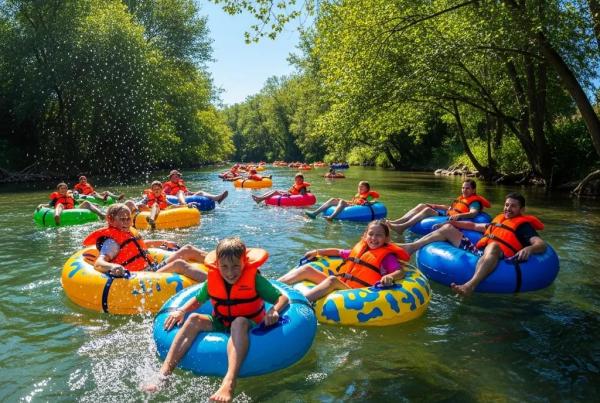
If you want a Michigan campground with swimming, look for a natural swim lake with a real sand beach rather than a pool. Walnut Hills Family Campground in Durand has a spring-fed swimming lake with a landscaped beach and a 14-piece Wibit floating water park, and the Shiawassee River runs along the same property.
Our sister park, The Oaks Campground in Munith, rebuilt its beach on an artesian-spring lake in 2026 and added an Aquaglide floating water park. Neither park has a pool; swimming is on natural lakes, with a monitor (not a lifeguard) on the water park. Below: what each swim lake is like, which campsites sit closest to the water, and how campground lakes compare with Michigan’s public beaches.
Campgrounds with swimming in Michigan: our two parks at a glance
| Walnut Hills (Durand) | The Oaks (Munith) | |
|---|---|---|
| Swimming | Spring-fed swimming lake, sand beach at the front of the park | Artesian-spring swim lake, new sand beach (2026) |
| Water park | 14-piece Wibit, open Tue-Sun; free for campers Tue-Thu | Aquaglide, new in 2026; wristbands at the store |
| Other water | Shiawassee River: floats, tubing, boat launch | Fishing lake with a dock; Portage Lake boat launch 9 minutes away |
| Pool | No | No |
| Lifeguard | No; a monitor staffs the Wibit | No |
| Beach hours | 9 a.m. to 9 p.m. or sunset | 9 a.m. to 9 p.m. or sunset |
Both parks are open May 1 to October 20. Swimming is at your own risk at both, children under 13 need an adult with them, and dogs stay off the beach and out of the swim areas.

Walnut Hills: a spring-fed swimming lake with a floating water park
The lake at Walnut Hills is fed by springs, which is why the water is naturally clear and stays cool on hot days. Swim out from the beach and you’ll hit cold pockets where spring water pushes up from below. A campground employee describes it as “very refreshing to experience,” and it is part of why local kids swam here in the 1960s and 70s, when the property was a canoe-float and swimming-hole business before it was a campground.
The water is also looked after. A lab designed a treatment program for the lake using products rated safe for human contact, so weeds, surface algae and bottom muck don’t build up.
The beach itself was rebuilt after GatherGrounds took over in 2022: fresh sand, a planter-box border of low shrubs with defined entry points to keep gravel off the sand, and a crushed-asphalt parking lot beside it. Because the beach sits at the front of the park next to the camp store, it is the first thing most families see when they arrive.
What the Wibit is and who can use it
The Wibit is a floating obstacle course anchored on the swim lake, with 14 pieces including an Action Tower XXL, two slides, monkey bars, a climbing wall, a rope climbing hill, a trampoline and jump-off platforms. Most campgrounds that have one run one to four pieces, so this is a large one for Michigan. It is open Tuesday through Sunday, free for registered campers Tuesday through Thursday, and a wristband fee on Friday, Saturday and Sunday that covers the cost of running it.
Riders must be 7 or older, guests under 16 need a parent present, and everyone wears the campground’s Wibit-designed life jackets (personal jackets aren’t allowed on the park). Check in at the store for a wristband, a waiver and a short safety video. A Wibit monitor on the dock checks wristbands and jacket fit and keeps everyone to the rules; there is no lifeguard. Expect to see parents and grandparents out there too, and campers in sites 1 to 15 holding up scorecards for the belly flops.
Which campsites are closest to the beach?
Sites 104 to 117 line the beach and cost a little more; across the road, the circle of sites 118 to 131 is long, wide and cheaper, which is why families book a few beach sites and fill the circle with the rest of the group. Lakefront seasonal sites are 101 to 103.
These beach-area sites are sunny (the sandy soil won’t hold big trees) and are 30-amp water-and-electric sites, so plan shade and a dump-station stop. The Walnut Hills map shows the layout, and the rates page has current pricing; RV sites start around the high $40s a night and vary by date and site.
The Oaks: a new sand beach and the Aquaglide
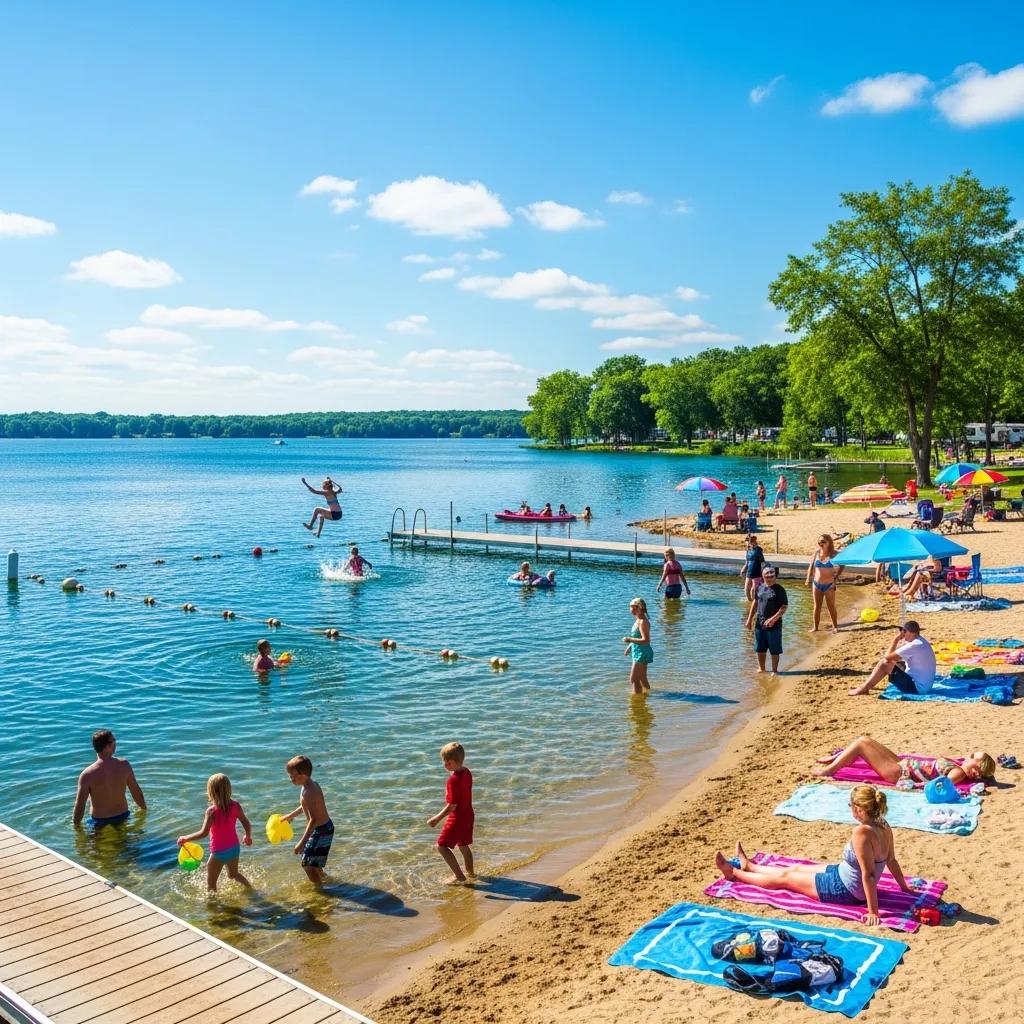
The Oaks’ swim lake is fed by a natural artesian spring, and the beach was the first big project after GatherGrounds took over at the end of 2025. The team treated the weeds, brought in hundreds of tons of sand with the help of Michigan Excavation Specialists, and ran the sand out into the lake so you step onto sand, not mud.
Campground lounge chairs sit on the beach (get there early for the good ones), a picnic lawn runs along the east side of the lake, and the lakefront RV sites are a short walk from the water. The Aquaglide floating water park opened the same spring and drew hundreds of swimmers on many weekends; wristbands come from the store, and it opens late morning. A free Kangaroo Jumper bounce pillow sits by the store and pavilion for kids who want a break from the water.
Camping with swimming and fishing
Many families want to swim and fish on the same trip. At Walnut Hills, fishing in the campground lake and ponds is catch-and-release, and on the swimming lake it is allowed only at the north end, away from the beach and the Wibit. The Shiawassee River is the bigger fishing draw there.
At The Oaks, the spring-fed swim lake spills into a separate, warmer fishing lake whose outlet connects to the Portage River watershed, which is one reason the fish run big; staff have seen photos of a child’s catch nearly as tall as the child. Kids do best on the dock, keeping fish is allowed (though most people release), and the store sells bait and gear. Our guide to Michigan campgrounds with fishing goes deeper on The Oaks lake and nearby Portage Lake.
Best lakes to swim in Michigan when you’re camping
Michigan has three kinds of swimming water, and each suits a different trip:
- Great Lakes beaches. Big sand, big water, and the coldest swimming. Michigan state park beaches on the Great Lakes use a flag system (green, yellow, red, double red) for wave and current hazards, and the DNR notes that state park beaches have no lifeguards, so you swim at your own risk.
- Inland lakes. Warmer, calmer and shallower near shore, which is why most families with young kids prefer them. Portage Lake in Waterloo Recreation Area, next door to The Oaks, has a public beach and an all-sports lake for boating; see our Portage Lake swimming guide.
- Private campground swim lakes. Smaller still, with no boat traffic, a beach a few steps from your site, and water that is managed through the season. At Walnut Hills and The Oaks the lakes are spring-fed, which keeps them clear and cool.
The practical difference is time. A public beach is a drive, a parking lot and a packed cooler. A campground beach is a walk or a golf-cart ride, with the campsite, the store’s scooped ice cream and the bathhouse a few minutes away, so kids can swim in the morning, nap, and swim again before dinner.

Campgrounds near lakes near me: who each park serves
Walnut Hills draws families from Flint and Genesee County, Lansing, the north Detroit suburbs in Oakland and Macomb counties, and the Saginaw, Bay City and Owosso area. Pick it for the bigger water park, the river, full-hookup 50-amp sites and the two camping cabins: camping near Flint, camping near Lansing.
The Oaks serves Jackson, Ann Arbor, Lansing and Detroit-metro families who want a quieter, more wooded park with 120 acres of trails next to Waterloo: camping near Ann Arbor. For lakefront and riverfront sites specifically, see our guide to Michigan campgrounds on the water.
Do Michigan campgrounds have swimming pools?
Some do; ours don’t. Neither Walnut Hills nor The Oaks has a pool. Both parks have a natural swim lake, and we think a floating water park on a spring-fed lake gives kids more to do than a pool deck. If a pool is a must for your family, filter for it when you book; if a sand beach, clear lake water and a floating obstacle course sound better, that is what we built. Our guide to Michigan campgrounds with water parks covers the Wibit and Aquaglide in more detail.
Frequently asked questions
Is there a lifeguard at the campground beach?
No. Swimming is at your own risk at both parks, and children under 13 must be supervised by an adult. The Wibit at Walnut Hills has a monitor who checks wristbands and life jackets, and guests under 16 need a parent present; a monitor is not a lifeguard.
Can non-campers use the beach?
Yes, on weekends and holiday weekends, with a day pass from the store. Day visitors register at the store and pay beach or water-park rates; see the rates page for current prices.
Can my dog swim?
Not at the beach or in the swim lake. At Walnut Hills, dogs can swim in the Shiawassee River near the boat launch; around the park they stay leashed, with the fenced dog park as the off-leash spot. At The Oaks, dogs can swim in the fishing lake, which is downstream of the swim lake, and they can be off leash on the back trails and in the dog run.
Is the water cold?
Both lakes are spring-fed, so they stay cooler than a shallow farm pond in July. Most swimmers call that a feature in August.
When is the beach quietest?
Tuesday through Thursday at Walnut Hills, when the Wibit is free for campers and the weekend crowd hasn’t arrived. May before Memorial Day and October are also slow, and site rates drop below the base rate then.