
If you’re looking for campgrounds near Michigan state parks, the best spot in southern Michigan is next to Waterloo Recreation Area, the largest state park in the Lower Peninsula at more than 20,000 acres. The Oaks Campground in Munith sits less than five minutes from Waterloo, shares a border with the Haehnle bird sanctuary, and is a short drive from Pinckney Recreation Area (which adjoins Waterloo) and Brighton Recreation Area. You can camp inside the state park itself at one of Waterloo’s campgrounds, or stay at The Oaks and have 50-amp short-term sites, a beach, trails and weekend events a few minutes from the park.
This guide covers the state parks near The Oaks, what camping is like in a Michigan state park campground versus a private one, how DNR reservations and the Recreation Passport work, what state forest campgrounds are, and what to check if you’re bringing an RV.
Which Michigan state parks are near The Oaks?
| State park | Size | Campgrounds | Known for |
|---|---|---|---|
| Waterloo Recreation Area (Chelsea / Grass Lake) | 20,000+ acres, 11 lakes | Portage Lake (136 modern sites), Sugarloaf Lake (164 modern), Green Lake (25 rustic), a 25-site equestrian campground, plus a group area and hike-in sites | 50+ miles of trails, the Gerald E. Eddy Discovery Center, Portage Lake (an all-sports lake with a public boat launch), equestrian trails |
| Pinckney Recreation Area (Pinckney / Gregory) | About 11,000 acres | Bruin Lake (161 modern), Crooked Lake (25 rustic), Blind Lake hike-in sites | The 17-mile Potawatomi Trail and 40+ miles of multi-use trail, popular with mountain bikers; connected to Waterloo by the 36-mile Waterloo-Pinckney Trail |
| Brighton Recreation Area (Howell) | About 4,950 acres, 9 lakes | Bishop Lake (144 modern), Appleton Lake and Murray Lake (25 rustic each), an equestrian campground | A 35-mile trail system for hiking, biking and horses; the Bishop Lake swim beach |
The Oaks is on the Waterloo side of this cluster. Portage Lake’s public boat launch is about 9 minutes from the campground, and the Haehnle Sanctuary viewing area, where several thousand sandhill cranes gather in late October and November, is a short drive out the front of the park. Our Waterloo camping guide goes deeper on the park itself.

Camp in the state park, or at a private campground near it?
Both are good choices, and they suit different trips.
Michigan state park campgrounds put you inside the park, often on the lake, at a lower nightly rate. Modern sites have electric service, flush toilets and showers; rustic sites have vault toilets and a hand pump. Public parks are funded and priced differently (fees, the Recreation Passport and public capital investment) and keep things simple: the campground is a place to sleep while you enjoy the park. Sites book six months out, and summer weekends at Portage Lake and Sugarloaf go fast.
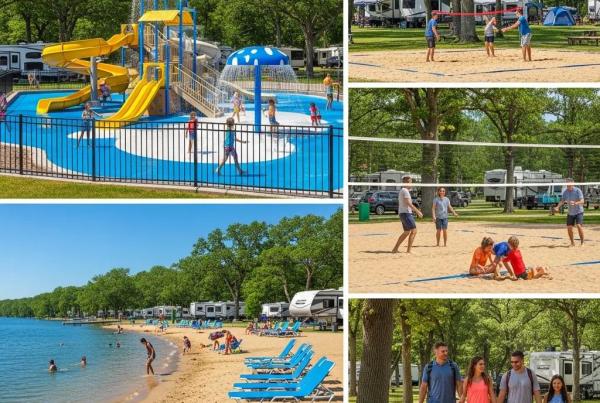
A private campground like The Oaks charges more per night because the site rate pays for the amenity stack, the staff and the utilities: a sand beach and Aquaglide floating water park, a free Kangaroo Jumper bounce pillow, 120 acres of trails for golf carts and bikes, a fishing lake with a dock, bathhouses with laundry, a renovated camp store, food trucks and weekend events with a DJ. Quiet hours from 11 PM to 8 AM mean your kids actually sleep, kids and bikes are back at the site by dusk, and golf carts park at dark, so evenings stay calm. Guests tell us they choose it for a well-kept, respectful, family atmosphere where the kids don’t run out of things to do.
As one campground employee described the idea behind The Oaks: people come because of Waterloo, “but then they realize they don’t really even have to leave.” For a longer comparison, see private vs public campgrounds and Michigan state park campground rates.
What The Oaks offers as a base camp
- Space. 155 acres, about 120 of them trails. The smallest sites are 35 by 65 feet and the largest are 55 by 120 feet, well above the roughly 33-by-60 standard, so awnings and slide-outs fit. Sites 46 to 61 are the biggest, with no neighbors behind them, and sites 22 to 109 are in the quiet old-growth section.
- Hookups. Electric (50 amp on short-term sites, 30 amp on seasonal) and water on every RV site, with a gray-water drain and honey-wagon service for black tanks. There are no sewer hookups and no pull-throughs. If you need 50-amp full hookups for a big rig, our sister park Walnut Hills in Durand has 80 of them.
- Water. A spring-fed swim lake with a rebuilt sand beach, the Aquaglide water park (wristbands at the store), lakefront sites and a separate fishing lake where kids do best on the dock. Bait and gear are sold at the store.
- Trails and wildlife. Several loops through forest and grassland for hiking, mountain biking, golf carts and horses brought in for the day. Deer, turkeys, herons and sandhill cranes that wander over from Haehnle are common sightings.
- Tent camping. Twenty tent sites in their own sections: T1 to T12 and sites 178 and 179 have electric, and T13 to T18 are primitive (no electric or water).
- Arrival. No office check-in; a license-plate gate goes live for 2027.
Details are on The Oaks amenities page, and rates on the rates page. Rates are dynamic: RV sites generally start in the $40s a night on slower dates and vary by date and site.

RV campgrounds near Michigan state parks: what to check
RV camping at state parks is popular, and the modern campgrounds at Waterloo, Pinckney and Brighton take RVs. A few things to confirm before you book anywhere:
- Power. Waterloo’s Portage Lake and Sugarloaf campgrounds list 30- or 50-amp service at the site. Rustic campgrounds have no electric at all. The Oaks has 50 amp on short-term sites (seasonal sites are 30 amp).
- Sewer. Michigan state park campgrounds generally offer a dump station rather than sewer at the site, so “full hookup” state campgrounds are rare. Full-hookup sites are mostly a private-campground feature; our full hookup campgrounds in Michigan guide explains where to find them.
- Site length. State park site lengths vary by loop; check the site details when you reserve. The Oaks’ sites run 65 to 120 feet long.
- Water sites. If you want to be on the water, both Portage Lake and Sugarloaf have lakeside loops, and The Oaks has lakefront RV sites a short walk from the beach. See waterfront camping in Michigan for more.
- Seasonal RV sites. State parks don’t offer seasonal sites. The Oaks does, at $2,500 to $3,300 for the May 1 to October 20 season, with free boat storage for seasonal campers who want to use the Portage Lake launch. See our seasonal sites page.
How do Michigan state park camping reservations work?
State park campsites are booked through the Michigan DNR at MiDNRReservations.com or by phone at 1-800-447-2757. One account covers campsites, cabins, yurts, lodges and harbor slips statewide.
Booking step by step
- Search by park, date or map. Type a park name, or open the map view and click a region to see every DNR campground in it.
- Pick a campground and a site. Each campground page shows a site map, photos and the details that matter: electric (20, 30 or 50 amp), pad length, shade, distance to the restroom, whether it’s a pull-through, and whether pets are allowed.
- Check the dates. During peak season (May 15 to September 15) the maximum stay is 15 nights, after which you need a 5-night break before returning to the same park.
- Pay. You pay the camping fee plus a non-refundable reservation fee of $8 online or $10 by phone.
- Buy or confirm your Recreation Passport (below). It isn’t included in the camping fee.
When do reservations open?
Six months before your arrival date, to the day. New inventory is released Monday through Friday at 8 AM and on Saturdays and Sundays at 9 AM, so a July holiday weekend books in January. The DNR’s advice for popular parks: book the morning your dates open, check back often because cancellations free up sites, and use the notification option for your dates (it alerts you to an opening but doesn’t hold anything). The most competitive campgrounds are the Lake Michigan beach parks such as Ludington, Mears and Grand Haven, and summer weekends at Portage Lake and Sugarloaf go fast too.
Using the reservations map
The reservation site’s map search is the closest thing to an official map of Michigan state park campgrounds: 103 state parks and recreation areas, about 140 state park campgrounds and roughly 13,500 campsites, plus the state forest campgrounds and harbors. It covers DNR properties only. National forest campgrounds (Huron-Manistee, Hiawatha and Ottawa) book through Recreation.gov, and private campgrounds like The Oaks book directly. Zoom into a campground’s site map before you commit: it shows which loops are on the water, which sites back onto woods instead of neighbors, and how far the restroom is.
What it costs: camping fees and the Recreation Passport
You’ll also need a Recreation Passport to drive into any state park, recreation area, state forest campground or DNR boat launch. For 2026 it’s $15 a year for Michigan residents when added at license-plate renewal ($5 more if bought at the park), $42 a year for non-residents, or $12 a day for non-residents. Prices adjust with inflation each January, so check the DNR’s Recreation Passport page for the current figure. You don’t need one to stay at The Oaks, but you’ll want one for day trips into Waterloo.
Nightly state park rates as of August 2025 run about $32 to $50 for modern sites, depending on location and electrical service, and $20 for rustic sites. That month the DNR raised modern and semi-modern rates by $4 to $10 a night.
Cancellation and change rules
These DNR rules trip people up, so here they are in one place for campsites:
| Situation | What it costs |
|---|---|
| Cancel or change more than 5 months before arrival | Not allowed; wait until you’re inside 5 months |
| Cancel the same day you booked | $10 fee only |
| Cancel before arrival | $10 fee plus a reduced-stay fee on the unused nights: 10% if you’ve held the reservation under 2 months, 15% for 2 to 3 months, 20% for 3 to 4 months, 30% for 4 to 5 months, 40% for 5 months or more |
| Change dates without changing the length of stay | $10 fee |
| Change parks | Cancel and rebook |
| Arrive late | Update the reservation by 3 p.m. on the second day or it’s canceled, with the $10 fee, up to two nights’ fees and the reduced-stay fee |
| Leave early after check-in | Reduced-stay fee on unused nights; check out before 1 p.m. to count that night |
Reservations can’t be sold or transferred to someone else. Pavilions, lodging and harbor slips follow different schedules; the DNR reservations FAQ has those.
What are state forest campgrounds in Michigan?
People searching for Michigan state campgrounds often mix up state parks and state forest campgrounds. State forest campgrounds are a separate system of 140-plus rustic campgrounds, almost all in the northern Lower Peninsula and the Upper Peninsula. Each has vault toilets, a hand-pump well, a picnic table and a fire ring, with no electric. Most are first-come, first-served, a few can be reserved, and the rate is $20 a night plus the Recreation Passport. There are none in the Waterloo area; the closest thing locally is Waterloo’s Green Lake rustic campground. If rustic is what you’re after, our rustic camping in Michigan guide covers the options.
At state forest campgrounds you claim a site by setting up camp and paying at the kiosk. Check-in is 3 p.m. and checkout is 1 p.m. (state park checkout is also 1 p.m.), and quiet hours run 10 p.m. to 8 a.m. Dispersed camping on state forest land is free with a posted camp registration card, at least a mile from any state forest campground.
Who should stay at The Oaks, and who should book the state park?
Book inside Waterloo if your trip is about the park: you’ll fish or ski Portage Lake every day, ride the equestrian trails from the horse camp, or hike the Waterloo-Pinckney Trail, and you want the lowest rate. Stay at The Oaks if you want the location plus a campground with things to do on site, a bigger site, real quiet hours and a camp store with scooped ice cream. Many families do both: a day at the Discovery Center or Portage Lake, then back to the beach, the trails and the pavilion. As our team says, “you can’t do everything at the campground and in the surrounding area in just one weekend.”
The Oaks is about 20 minutes from Jackson and a reasonable drive from Ann Arbor and metro Detroit; see our campgrounds near Jackson and campgrounds near Ann Arbor pages.
Frequently asked questions
Is The Oaks inside Waterloo Recreation Area?
No. It’s a private campground less than five minutes from Waterloo. The property borders the Haehnle Sanctuary, but golf carts can’t get into the sanctuary. You can hike from our back trails to its back side, and the public viewing area is a short drive away.
Do I need a Recreation Passport to camp at The Oaks?
No. The passport is required for vehicle entry to state parks and state forest campgrounds, so you’ll need it for Waterloo, Pinckney or Brighton day trips.
Can I bring my horse to The Oaks?
Day riding is allowed on our trails if you bring your horse from one of the nearby stables; manure must be bagged, and the trails are shared with golf carts and bikes. Waterloo’s equestrian campground is the better fit if you want to camp with your horse.
Where’s the nearest boat launch?
The public launch on Portage Lake, an all-sports lake in Waterloo, is about 9 minutes from The Oaks.
Can I reserve a Michigan state park campsite online?
Yes, at MiDNRReservations.com, where the reservation fee is $8 instead of $10 by phone. The site also has live chat and a contact form if you’re locked out of your account.
How many nights can I stay at a Michigan state park?
Up to 15 nights during peak season (May 15 to September 15). After 15 nights you must leave that park for at least 5 nights before camping there again.
Are state forest campgrounds on the reservation system?
Mostly no. Most of Michigan’s roughly 140 state forest campgrounds are first-come, first-served, with a few exceptions you can reserve online.
How do cancellations work at The Oaks?
If you cancel more than two weeks before arrival, you’re refunded minus a fee of $15 or 15% of the reservation, whichever is greater. Within two weeks of arrival, reservations can’t be refunded or rescheduled. Read the policy before booking anywhere, since every campground sets its own.