
For bird watching and nature camping in southern Michigan, The Oaks Campground in Munith is hard to beat: the 155-acre park shares a border with Michigan Audubon’s Haehnle Sanctuary, sits next to the 20,000-acre Waterloo Recreation Area, and has about 120 acres of its own forest, grassland and marsh trails where sandhill cranes, deer, turkeys, eagles, hawks and herons are regular sights. The campground doesn’t run guided tours itself, but the Haehnle overlook and the Gerald E. Eddy Discovery Center, both a short drive away, offer volunteer-led crane viewing and public nature programs.
Here’s what birders and nature-first campers can expect at The Oaks, how to visit Haehnle from the campground (hint: you drive, not golf-cart), where guided programs exist nearby, and what our sister park Walnut Hills offers for a river-and-woods version of the same trip.
Why The Oaks works for bird watchers
What sets The Oaks apart from most campgrounds near Waterloo is how much of its land is left wild. Our team puts it this way: “We have visited hundreds of campgrounds at this point and we have never seen one that had 120 acres of trails.” The trails run in several loops through mostly forest with stretches of grassland, and one loop heads toward the wetlands that border Haehnle Sanctuary. That’s where you’re most likely to see sandhill cranes that have wandered over from the sanctuary’s marsh.
Guests most often report:
- Sandhill cranes, singly and in family groups through the camping season, and in large numbers in fall.
- White-tailed deer, which seem to know there’s no hunting on the property. Jackson County is well known for deer, and the campground acts as a refuge, so sightings on the forest loops are routine, especially in the evening as deer head toward neighboring farm fields.
- Wild turkeys along the trail edges.
- Bald eagles and hawks over the fields and the fishing lake.
- Great blue herons working the shoreline of the fishing lake and the marsh.
You don’t even have to leave your car to see birds here. In summer and fall, birders park along the campground’s entrance drive to watch a field on the far side of the property from the sanctuary, which fills with birds that overflow from the protected land.
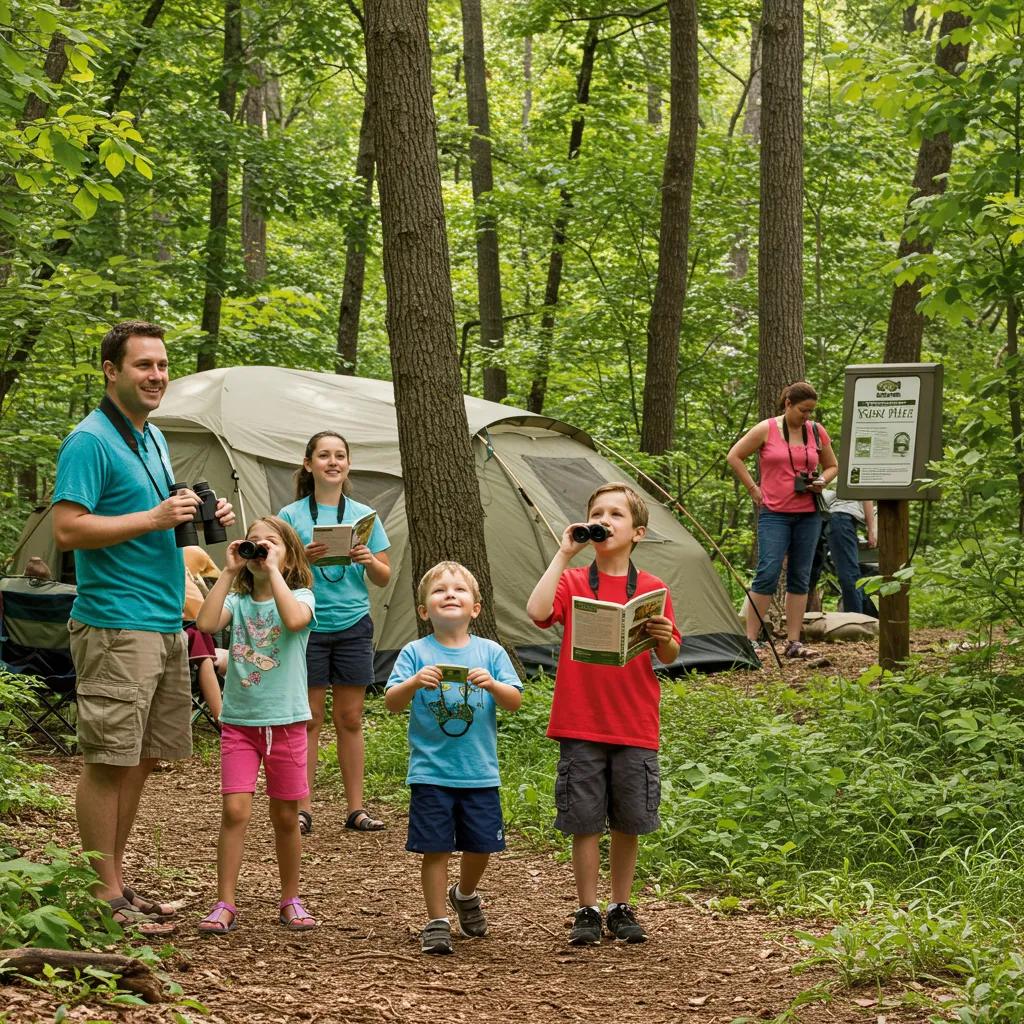
Many of The Oaks’ seasonal campers are retirees and grandparents, and bird watching is part of why they chose it. A common routine is a morning drive to the Haehnle viewing area, then an afternoon with binoculars on the back 120 acres, looking for the birds that have crossed onto the campground’s marsh and grassland.
Visiting Haehnle Sanctuary from the campground
The Phyllis Haehnle Memorial Sanctuary is Michigan Audubon’s largest sanctuary at 1,008 acres, managed with volunteers from the Jackson Audubon Society, and it’s open year-round from dawn to dusk. The public viewing area sits on a hilltop overlooking Mud Lake Marsh, with benches, a set of bleachers and interpretive boards on the sanctuary’s history. The sanctuary keeps sections of the grassy marsh mowed so you can walk out into it on maintained trails, and there’s parking, an information kiosk and seasonal restrooms in fall. More than 200 bird species have been recorded there.
Good to know before you go: you can’t reach the sanctuary from the campground by golf cart. The two properties share a border, which is why so much wildlife spills onto the campground, and you can hike from our back trails to the back side of the sanctuary, but there’s no cart path to its viewing area. To reach the viewing area, take a short drive out the front gate and around a couple of corners. It’s close, and the campground’s homepage video includes a clip of the viewing area so you know what you’re looking for.
When is the best time to see sandhill cranes near Jackson?
Cranes nest in the Waterloo and Haehnle wetlands, so you’ll see pairs and small groups all season. The spectacle, though, is the fall staging: from late October to mid-November, several thousand cranes gather at Haehnle each evening, flying into Mud Lake Marsh to roost in the hour before sunset. Jackson Audubon volunteers staff the overlook on Saturday and Sunday afternoons until sunset during crane season to help visitors count and identify what’s coming in. The Michigan DNR’s advice is the same: go at dusk, when you can watch and hear the birds settle in.
Our campground season runs May 1 to October 20, so the last two or three weeks of the season overlap with the start of the big crane numbers. October is also the quietest month at The Oaks, with fall color on the wooded trails and rates below the summer base. If you want the peak counts in November, you’ll be visiting the sanctuary as a day trip, but an October stay gets you the early arrivals, the color and a nearly empty campground.

Are there guided nature tours near The Oaks?
The Oaks does not run guided nature walks or naturalist programs. What it offers is self-guided access to a lot of wild land, plus two neighbors that do run programs:
- Haehnle Sanctuary is a self-guided sanctuary, but during fall crane season volunteers are at the overlook on weekend afternoons to help with viewing and identification.
- The Gerald E. Eddy Discovery Center in Waterloo Recreation Area (Chelsea) is a Michigan DNR visitor center with an exhibit hall on local habitats, a “critter room” of live local animals, a 12-minute film, a honeybee colony and a touch-screen bird game. It runs public programs for all ages, including night hikes and archery, and has trail guides for wildflower and insect walks. Summer hours are daily, 10 a.m. to 5 p.m., Memorial Day to Labor Day; it’s weekends only in spring and fall.
Waterloo itself is more than 20,000 acres with trails through forest wetlands and mature oak-hickory woods.
What a nature-first day at The Oaks looks like
Start early. Dawn is the best birding of the day, and the trailhead is near tent sites 178 and 179. Walk or bike the wetland loop first, while the cranes and herons are feeding and before the golf carts are out. Back at camp, the fishing lake is next: the dock reaches toward the middle of the lake and is where kids catch fish almost every time, while the far shore gives quiet bank fishing with herons for company. The store sells bait and gear.
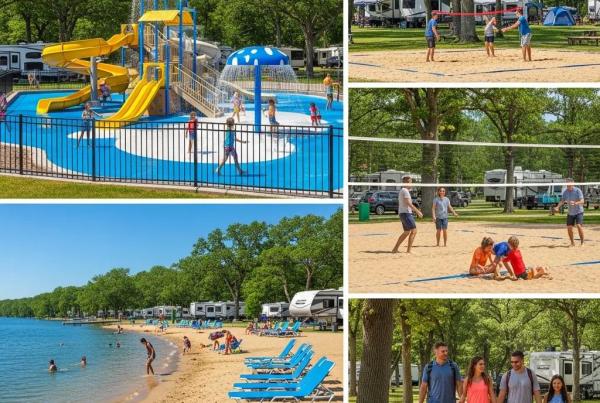
Midday belongs to the sand beach on the spring-fed swim lake, where the Aquaglide water park runs on wristbands and the campground sets out lounge chairs. Late afternoon, take a rented golf cart or your bikes back onto the forest loops for deer, then watch for cranes gliding over the fields toward the sanctuary at dusk. After dark, look up. The Oaks is remote enough that the stars and meteor showers are easy to see from any site.
A few habits keep it peaceful for everyone, wildlife included: quiet hours run 11 PM to 8 AM, kids and bikes are back at the site by dusk, and golf carts park for the night at dark, so the deer and the stars get the evening. Dogs are welcome: leashed in the campground, free to run off leash on the back trails and in the dog run, and welcome to swim in the fishing lake (not the swim beach).

Which sites are best for nature campers?
For quiet and shade, book in the older section, sites 22 to 109, which is known for its old-growth trees and distance from the amenity area. The row from site 46 to 61 has the largest lots in the park (40 to 55 feet wide and up to 120 feet long) with no neighbors behind you. Tent campers who want the trailhead close should look at sites 178 and 179 (electric and water). Short-term sites have 50-amp electric and seasonal sites 30 amp, all with water. See The Oaks map and rates page; nightly rates are dynamic and vary by date and site. More on the trail system is in our Michigan campgrounds with hiking trails guide.
Nature camping at Walnut Hills, our sister park
If you’d rather have a river than a marsh, Walnut Hills Family Campground in Durand, about an hour north, sits on the Shiawassee River with a nature trail along the bank inside the park. The back-fence-line sites (74 to 170B) look through a 30-foot band of old trees onto a farm field where deer graze most mornings; as one campground employee said, it’s “very peaceful back there when you wake up with a cup of coffee.” Float trips with Cheff’s Canoe Rental are a quiet way to see riverside birds, and golf-cart owners know about a public nature area on Reed Road that runs through woods to the river. It has no on-site trail network like The Oaks, so for miles of trails, choose The Oaks.
Bird watching tips for campers
- Go at dawn and dusk. Birds and deer are most active then, and the trails are emptiest.
- Bring binoculars, not bread. Never feed cranes, deer or waterfowl. Fed animals get bold around campsites.
- Give nesting birds room. Cranes nest in the wetlands in spring; watch from the trail and don’t push into the marsh.
- Keep your dog close in spring. Dogs can run off leash on the back trails, but ground-nesting birds and fawns are easy for a curious dog to find, so a leash or a close heel in nesting season helps the wildlife you came to see.
Frequently asked questions
Can I take a golf cart from The Oaks to Haehnle Sanctuary?
No. There’s no cart path from the campground to the sanctuary’s viewing area; you can hike from our back trails to the back side of the sanctuary, or drive to the viewing area. Drive out the front gate; it’s a few minutes away.
Does The Oaks offer guided nature tours?
No. The trails are self-guided. For programs, visit the Eddy Discovery Center in Waterloo Recreation Area or the Haehnle overlook on fall weekends, when Jackson Audubon volunteers are on hand.
What birds will I see at the campground?
Sandhill cranes, great blue herons, bald eagles, hawks and wild turkeys are the ones guests mention most, along with the deer that share the trails.
Is The Oaks open during the fall crane migration?
The season runs through October 20, so you can camp during the early part of the staging season. The peak at Haehnle is late October through mid-November.
Which Oaks trail loop is best for birds?
The loop that heads toward the wetlands bordering Haehnle Sanctuary. Sandhill cranes wander over from the sanctuary, and herons, hawks and eagles are regular sightings along the marsh and the fishing lake.
Where should nature lovers camp at The Oaks?
The older section, sites 22 to 109, sits under old-growth trees away from the amenities, and sites 46 to 61 are the largest lots with no neighbors behind you.