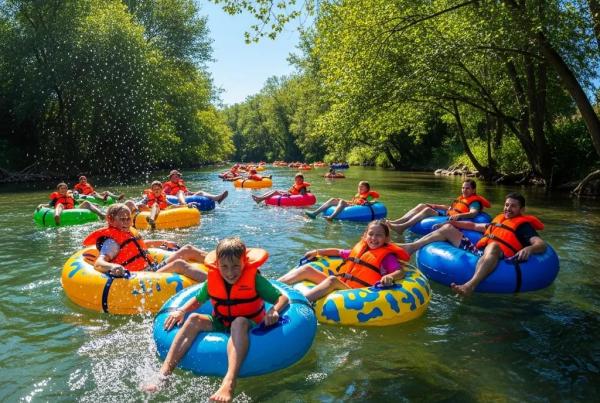
Before you kayak, canoe or tube the Shiawassee River at Walnut Hills Family Campground, check three things: the USGS river gauge at Owosso for current flow, the Friends of the Shiawassee River water-level and trip maps for recent paddler reports, and Cheff’s Canoe Rental, the independent outfitter that runs floats from the campground launch and decides each day whether trips go out. Life jackets are provided with every Cheff’s rental, and Michigan law requires one per person on the water, worn by every child under 6.
Walnut Hills doesn’t run a river gauge of its own, so here is where the real data lives, how the river behaves through the season, and the safety habits that matter on this stretch.
How to check Shiawassee River conditions before you float
- USGS gauge: Shiawassee River at Owosso (station 04144500). This is the real-time gauge downstream of the campground. It reports discharge in cubic feet per second (cfs) and gage height in feet. Look at the last few days, not just the current number: a falling line after rain means the river is settling; a sharp rise means wait.
- Friends of the Shiawassee River. The watershed group’s site links to water levels across the watershed and to a paddlers’ trip map where people post what they saw: downed trees, portages, low spots. Its own advice is the right one: if you have concerns, scout the stretch before you paddle it.
- Cheff’s Canoe Rental. Cheff’s launches from Walnut Hills and is on the river daily in season, so they know this stretch better than any gauge. Trip times “can change with the river conditions,” as their site puts it, and they’ll tell you whether the day suits tubes or only canoes and kayaks. Book or call through cheffscanoerental.com.
- The virtual river tour. Someone floated the Shiawassee with 360-degree cameras, and the tour is linked from the Walnut Hills home page. It won’t show today’s level, but it shows the bends, banks and the character of the water you’ll float.
- Weather. Check the forecast for thunderstorms. A float is two to four hours in the open with no quick exit, so a storm forecast is a reason to go in the morning or pick another day.
What river levels mean for kayaking and tubing on the Shiawassee
There’s no published “safe” cfs number for this river. What our team has learned from years of floats at Walnut Hills is seasonal:
| Time of year | Typical river | Best choice |
|---|---|---|
| Spring (April to May) | Faster, higher, cold water | Canoes and kayaks for experienced paddlers; not tube season |
| June to early August | Warm, steady current | Ideal for tubes; good for everything |
| Mid-August to October | Depends on rainfall | Good in a normal year; in a dry year the river gets low and trips run slow |
As one campground employee explained, “the water runs faster in the spring and is better suited for canoes and kayaks. Once you get into June, July and early August, it becomes ideal for tube floating.” In a drought year, the river “really is not great starting in early to mid-August,” but with decent summer rain “it can stay in good shape for float trips all the way through the end of the season.” Low water doesn’t usually cancel a trip; it makes it longer. One Cheff’s customer wrote that a 2-hour trip “ended up being 3 hours because the river was low.” Plan your day around that.
The Shiawassee has one advantage in low water. Paddlers who know other Michigan float rivers say it holds its depth well, so there’s less bottom-scraping in dry years. It’s also an 88-mile National Water Trail from Holly to Chesaning, and the water-trail groups and local volunteers work to keep the channel clear of fallen trees. That doesn’t mean every strainer is gone the day you float, which is why the trip map matters.
Are life jackets provided for river floating at Walnut Hills?
Yes, with Cheff’s rentals. Every canoe, kayak and tube rental comes with life jackets, fitted at the launch next to the camp store before the bus leaves. You can bring your own if you prefer, as long as it’s USCG-approved and in good condition.
If you float your own boat or tube from the campground, you supply the life jackets. Michigan law requires a USCG-approved life jacket for each person in a canoe or kayak, and every child under 6 must wear one while the boat is moving. Adults aren’t required to wear theirs while paddling, but our team’s position is that you should, every time. The river is calm, but a life jacket only helps if it’s on you when you tip.
One thing often mixed up: the life jackets on the Wibit floating water park are a separate system. The campground provides Wibit-designed jackets that can’t snag on the inflatables, and personal jackets aren’t allowed on the Wibit for that reason. River jackets come from Cheff’s or from you.
River floating safety on the Shiawassee
This is a gentle, flat-water river with a steady current, not whitewater. The hazards are the ordinary Michigan river ones, and they’re manageable with a few habits.
- Downed trees and strainers. The main hazard on any wooded river. Water flows through a fallen tree but you don’t. Give strainers a wide berth on the inside of the bend, and if the current pushes you toward one, lean toward the obstacle and climb over, never under.
- If you tip or slip out of a tube. Float on your back, feet downstream and up, and work toward the slow water on the inside of the bend. Hold onto your boat or tube if you can; let it go if it’s pulling you toward trouble. Stand up only in shallow, slow water.
- Cold water in spring. Even on a warm April day the river is cold. Dress for the water, not the air, and keep spring trips to canoes and kayaks with dry clothes in the car.
- Sun and heat. Two hours on open water in July is a lot of sun. Hat, shirt, sunscreen, and water in the cooler.
- Footwear. Water shoes or strapped sandals. The bottom is sand and gravel with rocks, and you will stand in it.
- Alcohol. Boating under the influence is illegal in Michigan and applies to paddlers. Keep the cooler tube for water and snacks when kids are along.
- Stay together. Tubers should link up; canoes and kayaks should keep each other in sight. Pick a meeting point if the group splits.
- Know your exit. On a Cheff’s trip the pull-out is set and the bus is waiting. On your own float, put a car at the downstream access point first.
For age, size and life-jacket rules in detail, see our guide to river tubing age restrictions and Michigan kayak rules.
Who checks the river each day?
Cheff’s does, because their trips depend on it. The campground team is on the river too: the boat launch sits next to the store at the front of the park, river-frontage sites 27 to 42 are right on the water, and staff see the level every morning. If the Shiawassee comes up after a storm, you’ll hear about it at the store. No one publishes a daily report for this stretch, though, so use the gauge, the trip map and a phone call to Cheff’s, in that order.
Picking the right trip for the day
Walnut Hills has more float options than most Michigan river campgrounds, which makes it easy to scale the trip to conditions and to the group:
- In-park float, about 30 to 45 minutes. Float from one end of the campground to the other with your own tubes. The best choice for small kids, first-timers, and days when you want to try the river before committing to a long trip.
- 2-hour tube float. Cheff’s uses a tube-only pull-out on a local farm so tubers aren’t out for 4 hours. Peak tube season is June through early August.
- 2-hour or 4-hour canoe and kayak trips. One starts upstream and ends at the campground launch; the other starts at the launch and ends downstream where Cheff’s bus meets you.
Two of the access points are public, so you can float from the campground without Cheff’s if you have your own gear and a second vehicle. Details and booking are in our guide to booking a river float trip or kayak rental.

Frequently asked questions
Does Walnut Hills cancel floats when the river is high?
Cheff’s makes that call, not the campground. In practice high water is a spring issue, when tubes aren’t running anyway. Call Cheff’s the morning of your trip if there’s been heavy rain. Campsite reservations are separate and follow the campground’s cancellation policy on the rates page.
Is the Shiawassee River safe for beginners?
Yes, in summer with life jackets. It’s a flat-water float with no rapids, and the shorter trips let beginners build up. Spring is the exception: faster, colder water that suits people who already paddle.
Can kids and dogs float?
Kids yes, with a life jacket (worn, by law, under age 6) and an adult in the same boat or within reach. Cheff’s doesn’t publish a minimum age, so ask when you book; on the campground’s Wibit water park, guests under 16 need a parent present. Well-behaved dogs are welcome on Cheff’s trips, and dogs can swim in the river at the Walnut Hills boat launch, though not in the swim lake or on the beach.
Where do I park if I’m not camping?
Day visitors meet Cheff’s at the canoe launch next to the camp store and pay a parking fee for the launch lot; the fee is on the rates page. Campers walk or take a golf cart up from their site. Walnut Hills is a 42-acre campground with 201 RV sites, 18 tent sites and two camping cabins; see Walnut Hills Family Campground and the amenities page for the rest of what’s on site, and our Michigan river tubing campgrounds guide for how the Shiawassee compares with other float rivers.