
The difference between public and private campgrounds comes down to who runs them and what they’re built for. Public campgrounds in Ohio, mostly state parks, are run by government agencies to give people affordable access to public land, so base fees are lower and the focus is on trails, lakes and scenery. Private campgrounds are businesses. They set their own prices and rules, and they usually charge more because they add hookups, planned activities, seasonal sites and on-site recreation. Plan your stay at Ridge Ranch Campground in Newton Falls.
Neither is better across the board. Below is how the two compare on price, amenities, booking rules, length of stay and atmosphere, with a Northeast Ohio example of each.
Public vs. private campgrounds at a glance
| Public (Ohio state parks) | Private campgrounds | |
|---|---|---|
| Who runs it | Ohio Department of Natural Resources (ODNR) | A private owner or company |
| Nightly price | Usually lower base fee, plus a reservation fee | Usually higher; set by each campground |
| Booking | Reserve Ohio (reserveohio.com), one statewide system | Each campground’s own website or phone |
| Hookups | Non-electric and electric sites are common; full hookups at some parks | Electric is standard; many offer water, sewer and 50-amp |
| Longest stay | 14 days in any 30-day period | Set by the campground; many sell monthly and seasonal sites |
| What you go for | Trails, big lakes, scenery, nature programs | The campground itself: beaches, pools or water parks, events, playgrounds |

What counts as a public campground in Ohio?
When people say “public campground” in Ohio, they usually mean a state park campground, booked through Reserve Ohio. Other public options include county and metro park campgrounds and the campgrounds in Wayne National Forest in southeast Ohio, which are reserved through Recreation.gov. Each agency sets its own fees and rules, so check the specific park.
A private campground is anything run as a business: family-owned parks, franchise campgrounds and resort-style RV parks. Some are basic overnight stops, others are destinations with their own lakes and event calendars.
How pricing differs between public and private campgrounds
Ohio state park pricing
State parks are subsidized public land, so the site fee itself is usually the cheapest way to camp in Ohio with a restroom nearby. Price depends mostly on site type (non-electric, electric or full hookup) and the park. On top of the nightly fee, Reserve Ohio adds a non-refundable reservation fee of $6.50 plus tax to every booking, and you pay in full when you book. Rates change, so check reserveohio.com for the park and dates you want rather than relying on a number from a blog.
Private campground pricing
Private campgrounds have to pay for everything themselves: land, taxes, utilities, staff and every amenity. Their prices reflect that, and they vary much more than state park prices. Things that move the price at a private park:
- Site type and location. Lakefront, full-hookup and 50-amp pull-through sites cost more than interior or tent sites.
- Dates. Summer weekends and holiday or event weekends cost the most. Weeknights and spring and fall are usually cheaper.
- Party size. Many private parks include a set number of people in the base rate and charge for extra adults or children.
- Add-ons. Some amenities are included and some are pay-per-use, such as a water park, golf cart pass or pavilion rental.
- Length of stay. Weekly, monthly and seasonal rates bring the per-night cost down a lot.
When you compare, look at the total for your trip, not just the nightly number. A state park site plus a day at a water park or two days of driving to activities can cost more than a private campground where the kids have a beach and something going on all weekend.

Amenities and hookups
Ohio state parks are strongest on the outdoors: hiking and mountain bike trails, large lakes with boat ramps, swimming beaches and nature programs. Campsites usually come with a fire ring and picnic table, and many parks have shower houses. Full-hookup sites exist at some parks but aren’t the norm everywhere.
Private campgrounds tend to put more into the campsite and the campground itself: full hookups and 50-amp service, Wi-Fi, camp stores, playgrounds, sports courts, planned weekend activities and, at some parks, pools or inflatable water parks. If you’re in a big rig, rely on onboard appliances or want the kids entertained without leaving the park, private usually fits better.
Booking rules and length of stay
Reserve Ohio has one set of rules for every park on the system. Campsites open six months before arrival, weekends require two nights (three on Memorial Day and Labor Day weekends), and stays are capped at 14 days in any 30-day period. There’s a fixed cancellation schedule, and parks on the system no longer hold back walk-in sites. Our Reserve Ohio guide walks through the full process and fees.
Private campgrounds each write their own rules: booking windows, minimum stays on holiday or event weekends, check-in times and cancellation terms. Read them before you pay, because they’re often stricter than people expect. The biggest practical difference is length of stay. Because of the 14-day cap, state parks don’t offer seasonal camping. If you want to keep your camper on one site all summer, or stay a month at a time, that’s a private campground. See our guides to seasonal camping in Ohio and extended-stay discounts.

Atmosphere, privacy and secluded sites
State park campgrounds sit inside larger natural areas, so even a busy campground backs up to woods or water, and evenings are quiet. Many people looking for secluded camping start there. Private campgrounds are often busier at the center, near the beach, store and pavilion, but most have quieter corners too. When you book, ask which part of the park is quietest, or which sites have no neighbor behind them. Private parks are usually happy to point you to the right section.
A Northeast Ohio example of each
Public: West Branch State Park (Portage County)
West Branch State Park near Ravenna sits on the 2,650-acre Michael J. Kirwan Reservoir, with unlimited-horsepower boating, a 700-foot sand beach, a marina, about 14 miles of hiking trails, a mountain bike trail system and disc golf. Its campground has electric and full-hookup sites. It’s a strong pick if your weekend is about boating, fishing and trails on a big lake.
Private: Ridge Ranch Campground (Newton Falls)
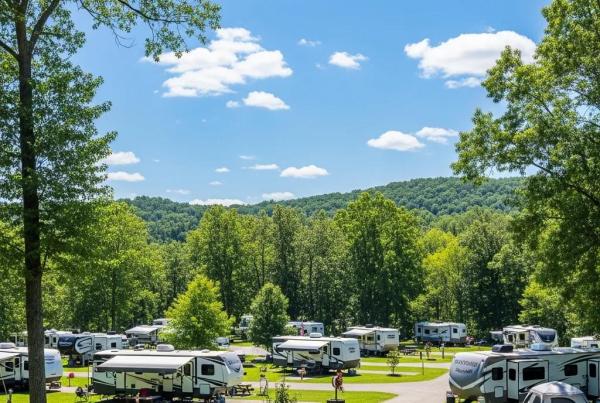
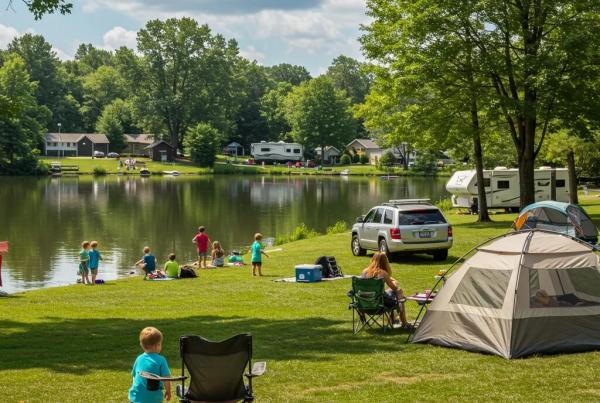
Ridge Ranch Campground in Trumbull County is a resort-style private park where the campground is the destination. The 76-acre property centers on a 17-acre lake with a new sand beach, a Wibit inflatable water park, a Kangaroo Jumper bounce pillow, a new playground, an arcade and a lakeside pavilion built by local Amish craftsmen that hosts weekend events. Guests can bring their own kayaks and canoes, and fishing is catch and release.
How its pricing works shows the private model in practice:
- Nightly RV sites start in the low-to-mid $40s and vary by site and date. The base rate covers two adults and two children, with a per-night charge for extra people. See the rates page for current pricing.
- Monthly stays are available at regular nightly rates (no monthly discount).
- The Wibit is pay-per-use rather than built into site rates, so guests who don’t use it don’t pay for it.
- Seasonal sites run May 1 to October 20, with free winter storage for returning seasonals and electric billed on actual usage through sub-meters.
Site areas also show how much a private park can vary: lakefront sites 138–156 are the most requested, the wooded full-hookup loop (65–131) is the quiet side, and sites 33–61 have no neighbor behind you.
The two places work well together. Plenty of families camp at a state park for a hiking or boating weekend and at a private park when the kids want a beach and something happening every day. Ridge Ranch is also about 10 minutes from Nelson Ledges State Park, so you can do both in one trip.
Which should you choose?
- Choose a state park if your priority is trails, a big lake for boating, a lower base price and a quiet, natural setting, and you’re staying two weeks or less.
- Choose a private campground if you need full hookups or 50-amp service, want on-site activities for kids, want flexible or longer stays, or want a seasonal site.
- For a quick overnight on the road, either works. A private park near the interstate with pull-through sites is usually the easiest in a big rig.
Public vs. private campgrounds FAQ
Are public campgrounds cheaper than private campgrounds in Ohio?
Usually, on the nightly site fee. Add the Reserve Ohio reservation fee and what you’ll spend on activities elsewhere, then compare totals.
Do Ohio state parks have full hookup sites?
Some do. Many state park campgrounds are mostly electric or non-electric, so filter by site type on reserveohio.com before you pick a park.
Can you camp all summer at an Ohio state park?
No. State park stays are limited to 14 days in any 30-day period. For a full season on one site, look at private campgrounds with seasonal sites.
Do private campgrounds use Reserve Ohio?
No. Each private campground takes its own reservations, online or by phone, under its own policies.