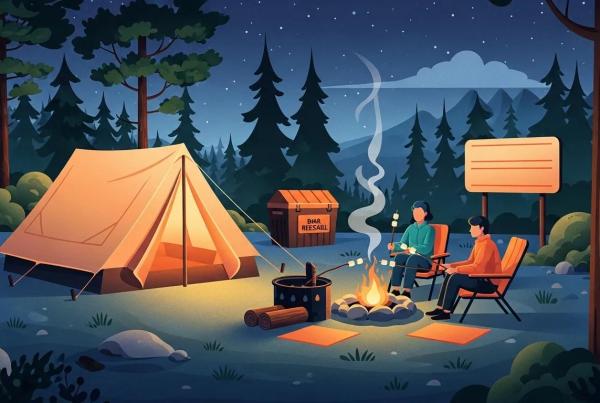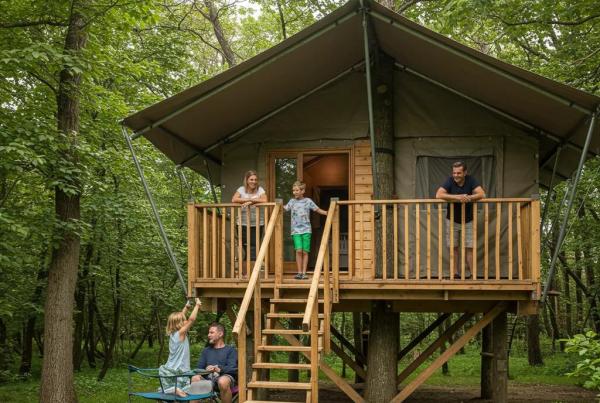

Camping under the stars doesn’t require a trip to a certified dark sky park. Walnut Hills Family Campground in Durand, Michigan, sits in farm country with little light pollution, so on a clear night you can see the Milky Way, planets and meteor showers from your own campsite. Walnut Hills also keeps a fleet of telescopes and hosts a stargazing event during the season, and quiet hours start at 11 PM, so the campground gets genuinely dark and still. Our sister park, The Oaks Campground in Munith, is just as remote, with 155 acres and open grassland along its trails.
Here’s what makes a campground good for stargazing, where to set up at our parks, when to come for meteor showers, and the Michigan dark sky parks worth a longer trip.
What makes a campground good for stargazing camping?
Three things matter most, and none of them is a certification:
- Distance from city light. Skyglow from a metro area washes out faint stars for miles. A rural campground surrounded by farm fields and woods, like both of ours, sits well outside that glow.
- Dark campground lighting at night. A park that enforces quiet hours and keeps vehicles parked after dark stays darker than one with headlights sweeping the loops until midnight. At our parks, kids and bikes are back at the site by dusk and golf carts stay parked after dark, so no headlights sweep past your window once the campground settles in for the night. The side effect is a darker sky for everyone.
- An open patch of horizon. Old-growth trees are great for shade and terrible for astronomy. You want a spot with a wide view of the sky, which is why we point stargazers to specific areas below.

Camping under the stars at Walnut Hills
When we asked our team for the single best dark-sky spot at each park, the answer was that there isn’t one: “Anywhere you are in the campgrounds, you’re going to be able to see the stars. All of our campgrounds are incredibly remote, so there’s not a lot of light pollution, and it’s very easy to see meteor showers and stars.” Still, some spots give you more sky than others.
Where to look up
- The beach and the sites by the swim lake (106 to 131). The sandy soil near the lake doesn’t support big trees, so this is the most open part of the park, with the lake in front of you and no canopy overhead. Sites 118 to 131 form a loop of long, wide sites around a large open middle.
- The back fence line. The sites along the back of the park (roughly 74 through 170B) have no neighbors behind them, just a band of old-growth trees and then a neighbor’s farm field where deer graze in the morning. Walk to the edge of the field and the horizon opens up.
- Your own site. Most of Walnut Hills is wooded, which means plenty of sites have a window of sky between the trees. Let your fire burn down to coals, turn off the lanterns, and give your eyes 15 to 20 minutes to adjust. The campground map (north is up) shows which sections are open and which are wooded.
Telescopes and the stargazing event
Walnut Hills keeps a fleet of telescopes, and a stargazing event is part of the events calendar. Dates change year to year, so check the calendar or ask at the store when you book. It’s a good first telescope experience for kids: the Moon, Jupiter’s moons and Saturn’s rings all show up in a modest scope, and someone else handles the setup.
Stargazing camping at The Oaks
The Oaks is the more rural of our two parks. The drive in passes almost no houses, and the property is 155 acres, about 120 of them trails through forest and grassland. For night-sky camping, the open spots are the sand beach and the picnic lawn on the east side of the swim lake, and the lakefront sites. The trails are wonderful by day, but they’re for daylight; golf carts stay parked after dark, so plan your evening sky-watching near the lake or at your site. Sites 46 to 61 in the older section have no rear neighbors and the largest lots in the park, which helps if you want to set up a telescope or a blanket without a camper behind you. See The Oaks Campground for the layout.

When is the best time for night sky camping in Michigan?
Our season runs May 1 to October 20, which covers the best of the Michigan sky calendar.
| When | What you’ll see | Notes |
|---|---|---|
| Early May | Eta Aquariid meteor shower (peak around May 5 to 6) | Best in the hours before dawn; nights are cold, so bring blankets |
| June to August | The Milky Way core in the southern sky | Late evening, darkest around the new moon; summer nights are short, so true dark comes after 10:30 PM |
| August 12 to 13 | Perseid meteor shower peak | The most popular shower of the year, with 30 to 50 meteors an hour from rural sites in a good year |
| October | Long, dark nights; crisp, clear air | Our quietest month and a discounted one; the Orionids peak October 21 to 22, right after we close |
Two more timing tips. First, check the moon: a full moon is beautiful but it hides most of the Milky Way, so plan a stargazing trip within a few days of the new moon. Second, plan on a weeknight or a Sunday night when the park is quieter and fewer campfires and lanterns are going. Weekdays also mean free Wibit access for campers Tuesday through Thursday, so you get the water park by day and the sky by night.
Camping and stargazing: a simple night routine
- Eat early and let the fire die down. A roaring fire is the brightest light in the campground. Coals are perfect for s’mores and don’t wreck your night vision.
- Use red light. A red headlamp or a phone with a red-screen setting keeps your eyes dark-adapted. Point white flashlights down and away from neighbors.
- Bring a blanket or reclining chairs. Lying back beats craning your neck, especially for meteor showers, which are best watched with your naked eye and a wide view.
- Download a sky app before you arrive. Cell coverage is fine, but an offline star chart saves you from a bright screen.
- Keep it quiet after 11 PM. Quiet hours run 11 PM to 8 AM at all our parks. Whispered constellation-spotting is part of the fun, and the quiet means the kids actually sleep once they’ve spotted their last shooting star.
One of our team described the end of a camping day at The Oaks this way: “After s’mores the kids head off to bed and the parents get a few calm moments to end their day together. All those activities may seem like they’re geared toward kids, but we think that last peaceful hour of the day makes the parents the real winners.” That hour is when the stars come out.

Are there dark sky campgrounds in Michigan?
Yes, and if a certified dark sky is the whole point of your trip, Michigan is one of the best states in the country for it. The Michigan DNR lists six state-designated dark sky preserves inside state parks: Lake Hudson Recreation Area (Lenawee County), Negwegon State Park (Alcona County), Port Crescent State Park (Huron County), Rockport Recreation Area and Thompson’s Harbor State Park (Presque Isle County) and Wilderness State Park (Emmet County). It also lists three international dark sky parks certified by DarkSky International: Headlands in Emmet County, Keweenaw Dark Sky Park in the Upper Peninsula and Dr. T.K. Lawless Park in Cass County.
Of those, Lake Hudson is the closest to The Oaks, roughly an hour south in Lenawee County, and it makes a good day-and-evening trip from a base at The Oaks. The rest are a long drive from southeast Michigan, and several are rustic. To be clear about what we are: Walnut Hills and The Oaks are not designated dark sky preserves. They’re rural family campgrounds with dark surroundings, full amenities, a beach to fill the daytime and a sky that’s far better than anything you’ll see from Detroit, Flint, Lansing or Ann Arbor. For most families, that’s the right trade: camping under the stars without a six-hour drive.
Frequently asked questions about stargazing camping
Can you see the Milky Way at Walnut Hills or The Oaks?
On a clear, moonless summer night, yes. Look south after about 10:30 PM from an open spot like the beach. It appears as a faint, hazy band; it won’t look like a long-exposure photo, but it’s unmistakable once your eyes adjust.
Do I need a telescope for astro camping?
No. Meteor showers and the Milky Way are best with the naked eye, and binoculars show the Moon and star clusters well. Walnut Hills’ telescope fleet comes out for the stargazing event, so you can try one before buying.
What is the best site for stargazing at Walnut Hills?
Any open site near the swim lake (106 to 131) or along the back fence line. If you’re in the wooded sections, walk to the beach after dark; it’s a few minutes from anywhere in the park.
Is October good for stargazing camping?
It’s our favorite. Nights are long and clear, the park is quiet, and October rates run below the base rate. Dress for frost. See Walnut Hills rates and our guide to fall camping in Michigan.
Ready to camp under the stars? Book a site at Walnut Hills Family Campground or The Oaks Campground, pack a blanket, and leave the lantern off.